
































NASA Research in Chemical Science Reveals Organic Molecules on Mars
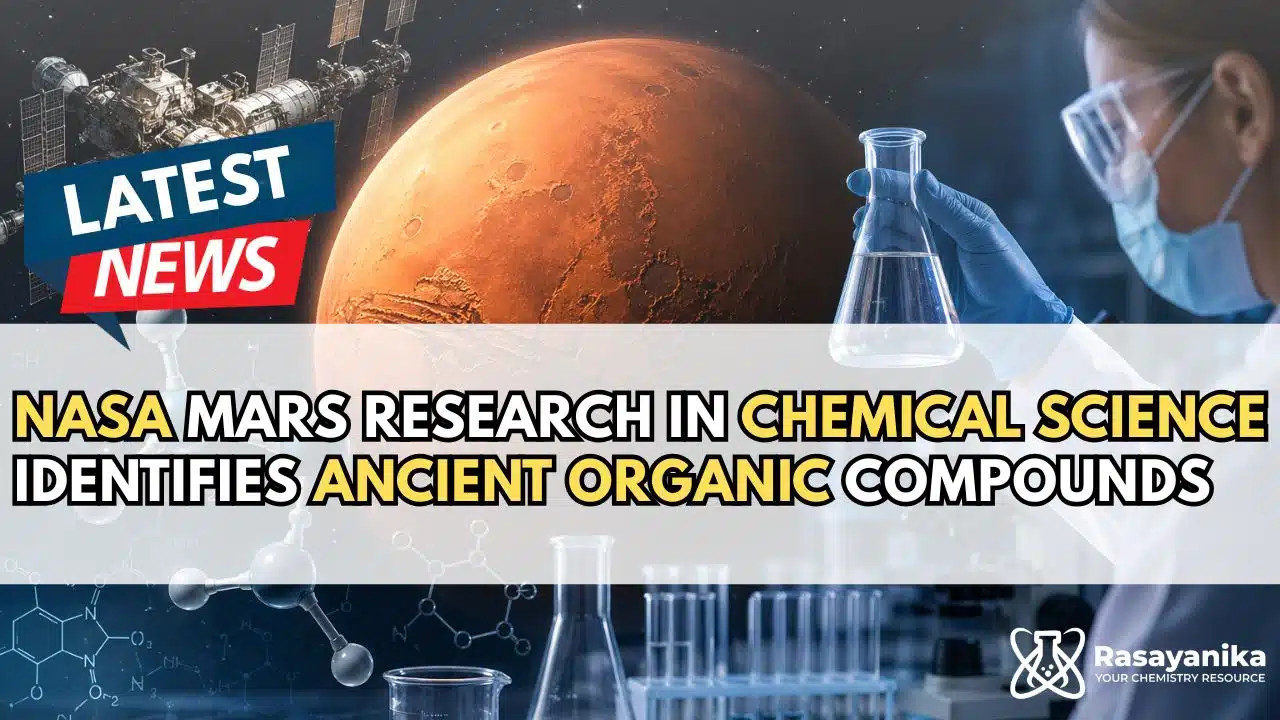
NASA’s Curiosity rover has found a wide range of organic molecules on Mars. These carbon-based chemicals are seen as important building blocks for life on Earth. This finding comes from a NASA research study carried out using a special experiment on Mars for the first time.
Situated within the Glen Torridon area of Martian geology, scientists are confident that if any life had existed on Mars, the environmental conditions would have been able to support it. NASA’s current research shows that the Martian surface can be a long-term repository for organic molecules. Nevertheless, researchers caution that while some organic molecules may exist, they do not establish that life has existed on Mars. These organic molecules may originate from multiple natural sources (e.g., from natural chemical processes, from ancient water systems and, possibly, from meteoritic impacts).
To confirm any real sign of past life, samples from Mars would need to be brought back to Earth for detailed testing.
The research was led by Amy Williams, a geological sciences professor at the University of Florida, who works with both the Curiosity and Perseverance rover teams. Curiosity landed on Mars in 2012 to study whether the planet once had conditions suitable for microbial life. Perseverance, which landed in 2021, is searching for direct signs of ancient life.
In this NASA research, scientists believe they are studying organic material that may have been preserved for about 3.5 billion years. Williams explained that finding preserved organic matter is very important because it helps scientists understand whether an environment could once support life.
The chemical analysis identified over 20 types of compounds, including a nitrogenous molecule resembling parts of the structure of DNA found on Earth; it’s the first time such a compound has been reported on Mars. Additionally, the chemical analysis discovered “benzothiophene” (a compound that contains sulfur) typically found in meteoritic materials.
Scientists also believe meteorites may have delivered similar organic chemicals to both Mars and Earth in the past, possibly helping form the basic ingredients needed for life.
The samples were collected from Gale crater, an ancient lake bed rich in clay minerals. These clays are very good at trapping and preserving organic materials over long periods of time.
The analysis was done using Curiosity’s Sample Analysis at Mars (SAM) instrument. In this NASA research, scientists used a chemical called TMAH to break large organic molecules into smaller parts so they could be studied by the rover. Because the rover carries only a small amount of TMAH, scientists had to carefully choose the best sampling site.
The findings were published on April 21 in the journal Nature Communications.
This NASA research is also helping future space missions like the Rosalind Franklin rover and the Dragonfly mission to Saturn’s moon Titan. Scientists say these missions may use similar methods to search for signs of organic chemistry and possible clues to past life.