























Table of Contents
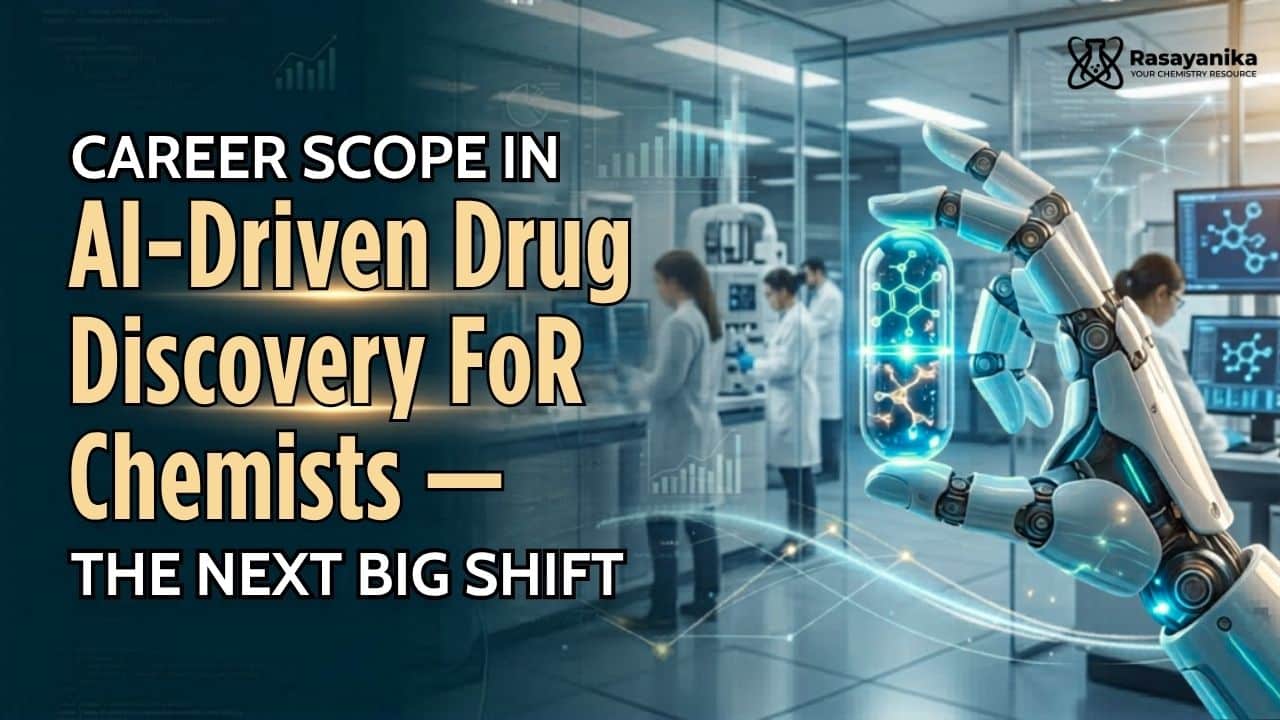
Career Scope in AI-Driven Drug Discovery for Chemists — The Next Big Shift
In one of the recent reviews published in Royal Society of Chemistry journals, researchers noted that more than 90% of drug candidates fail before reaching the market, and the average drug takes more than a decade to develop. As a result, scientists are now looking to implement AI in Drug Discovery. When we think about drug discovery processes, you might feel that these are just a routine process for scientists, but in reality, it is far more complex, time consuming & uncertain than it seems. That is the reason many drug candidates fail to work and to reach the market.
Now imagine sitting in a chemistry lab, carefully studying reaction pathways, optimizing conditions, and trying to understand why a molecule behaves a certain way… while somewhere else, a computer is already predicting which compounds might work before a single experiment is even performed.
This contrast shows how advanced drug discovery has become. Many chemistry graduates often realize this during a final-year project, a research internship, or while reading Computational Chemistry or about how companies now use machine learning models to design and filter molecules long before they reach the lab bench.
It might raise a simple question- “Should we still rely on the traditional lab methods or use AI in Drug Discovery, which will be guided by intelligence, not uncertain experimentation?” This is the shift toward AI-driven drug discovery, where chemistry now includes data, prediction, and computation alongside lab work. For today’s chemistry students and researchers, this is no longer a future change; it is already the new normal.
In this article, we will also explore AI in drug discovery careers for chemistry students, what computational chemistry and molecular modeling mean, and see how AI-driven drug discovery actually works in modern research and its advantages.
The Shift: From Trial-and-Error to Smarter Discovery
For a long time, drug discovery worked on trial and error. Scientists would test a number of compounds, run experiments more than a thousand times, and slowly narrow things down. It is a very slow, expensive, and uncertain process. Sometimes it could take more than 10 years to develop just one drug, or it may fail to be effective.
Now things are changing with the rise of AI in drug discovery because now researchers can analyze a huge amount of data and predict which molecules are worth testing, even before stepping into a lab. This would save the time and effort they put into long laboratory hours.
Research published in Frontiers in Chemistry and ACS Omega shows that AI is already helping in identifying drug targets, designing molecules, and optimizing compounds. This highlights how the AI-Driven Drug Discovery approach is saving both time and cost.
So, in simple terms, the approach is shifting: from a traditional process to a smarter drug discovery process.
So… Where Do Chemists Fit In This New Era?
This question might have made you quietly worry.
“If AI can do all this, what happens to chemists?”
But the truth is, AI still needs a chemist. An AI model can quickly suggest thousands of molecules that can be a possible candidate for a drug, but it can make mistakes, and this is where chemistry domain knowledge is required, and here is your role. A person who understands chemistry can tell if the molecule predicted by AI is possible to make in a lab or if it will behave safely in the human body. The AI-Driven Drug Discoveries will still need a trained chemist like you.
The reason why chemists are important
- Check if a molecule actually makes sense
- Understand how it can be synthesized
- Interpret what the results really mean
- Connect theory with lab work
Even research from ACS Omega makes it clear that experimental validation is still essential.
So instead of replacing chemists, AI is changing or advancing the chemist roles. It’s creating a new kind of professional: AI Chemist.
The AI world will not replace you, but you need to upgrade your skills in order to sustain. So, it requires chemists who can work with AI, not against it.
You can upgrade this AI skill in our course “ AI in Chemistry & Cheminformatics Training Program.” For more information, CLICK HERE.
Emerging Career Paths in Chemistry You May Not Know Yet
This shift has quietly opened new career opportunities for chemistry graduates, especially in AI in drug discovery careers for chemistry students.
Here are a few you should know:
1. Computational Chemist
This is a role that uses computational chemistry and molecular modeling to predict how molecules behave before they are actually made in the lab. It helps in predicting if the molecules will work or not.
2. Cheminformatics Specialist
In this role, a chemist works with chemical databases and molecular patterns and helps in understanding large sets of chemical information.
3. Drug Discovery Data Analyst
This is a role where you will analyze chemical and biological data to support the early drug design processes.
4. AI-Integrated Research Scientist
In this role, you will test the AI-predicted molecules in a lab and improve models by using real experimental results.
These roles are all part of the growing world of AI-driven drug discovery
India’s Growing Opportunity in AI-Driven Drug Discovery
India has one of the largest and strongest pharmaceutical industries in the world. It produces about 50-60% of global vaccines and around 20% generic medicines. It ranks 3rd in the world by pharmaceutical production volume. This means India can quickly adopt new technologies like AI in drug discovery. Some companies are already working with drug production that can be combined with AI, computational Chemistry, etc. Organizations like NITI Aayog are also pushing for AI adoption in healthcare.
This combination means there is going to be a high demand for people who understand both chemistry and technology.
Salary Expectations in AI-Driven Drug Discovery
Roles that combine chemistry with AI skills are growing faster and often pay better than traditional lab roles. The following table gives a rough idea about the salary ( it may vary based on location and company, and it was sourced from Glassdoor)
| Role | Entry-Level | Mid-Level |
| Computational Chemist | ₹5–8 LPA | ₹12–18 LPA |
| Cheminformatics Specialist | ₹6–10 LPA | ₹15–25 LPA |
| Drug Discovery Analyst | ₹5–9 LPA | ₹12–20 LPA |
If you combine chemistry with tech skills, your growth speeds up.
AI in drug discovery careers for chemistry students.
Are you wondering, “How to start”? Well, you do not need to completely change your degree or career path to enter this field. You just need to build and upgrade your skills and knowledge on what you already know from chemistry.
Start small and keep it simple:
- First, learn the basics of Python; it will help you understand how computers understand and handle data.
- Understand how data works, like how it is stored, cleaned, and used to solve problems.
- Explore simple computational chemistry tools to see how molecules are studied on a computer. (e.g., MOE, Open Babel, RDKit, autodock Vina, etc.)
Then slowly move into:
- Once you are confident with the basics, slowly move into more focused areas like Cheminformatics.
- Explore and research the applications of AI in drug discovery
- Apply for projects or internships to get real hands-on experience.
In Rasyanika, we are offering a course “ AI in Chemistry & Cheminformatics with real hands-on training”. Gain real skills and learn from experts. Become a chemist who is comfortable with technology.
Drug discovery is undergoing a major change, but the heart of it is still chemistry. Earlier, chemists mainly relied on lab experiments, testing compounds step by step. Now, with the rise of AI in drug discovery, a lot of the early work is being supported by computers that can predict molecules, analyze data, and suggest promising drug candidates before experiments even begin. Research from Frontiers in Chemistry, MDPI, and ACS Omega clearly shows that this approach is already improving speed and reducing failures in research.
But even with all this progress, AI cannot replace a chemist. It does not understand reactions, lab conditions, or real chemical behavior the way a trained scientist does. That is why experimental work and chemical knowledge are still essential.
What is really changing is the role of chemists. Today, they are not just working at the lab bench; they are also working with data, models, and simulations. New opportunities are opening up in areas like computational chemistry, molecular modeling, and data-driven research.
For chemistry students, this is an important moment. The field is not shrinking; it is expanding into new directions. Those who learn to combine chemistry with basic digital and analytical skills will be better prepared for the future.
Chemistry is still at the center of drug discovery, but now it is being supported by intelligence, technology, and data.









I am 25 year old Post Graduated in Msc chemistry want to do this course presently working in Dabur India limited as a production chemist want to make my carrier better .. kindly guide me