































NASA Discovery: Hidden Methane on Interstellar Comet 3I/ATLAS
NASA’s James Webb Space Telescope has detected the first mid-infrared chemical signature on interstellar comet 3I/ATLAS (where “3I” denotes the third confirmed interstellar object observed passing through the Solar System, following 1I/ʻOumuamua and 2I/Borisov), which provides scientists with a new insight into the composition of an object that originated beyond the solar system. The findings, recently published in The Astrophysical Journal Letters, mark the first direct detection of methane on an interstellar visitor.
The observations were conducted in two sets using the James Webb Space Telescope, a Mid-Infrared Instrument (MIRI), after Comet 3I/ATLAS passed perihelion (its closest approach to the Sun). The first session of MIRI observations was performed on December 15 and 16, 2025 (about 329 million kilometers/205 million miles from the Sun). The second MIRI session was on December 27, 2025 (about 379 million kilometers/236 million miles from the Sun).
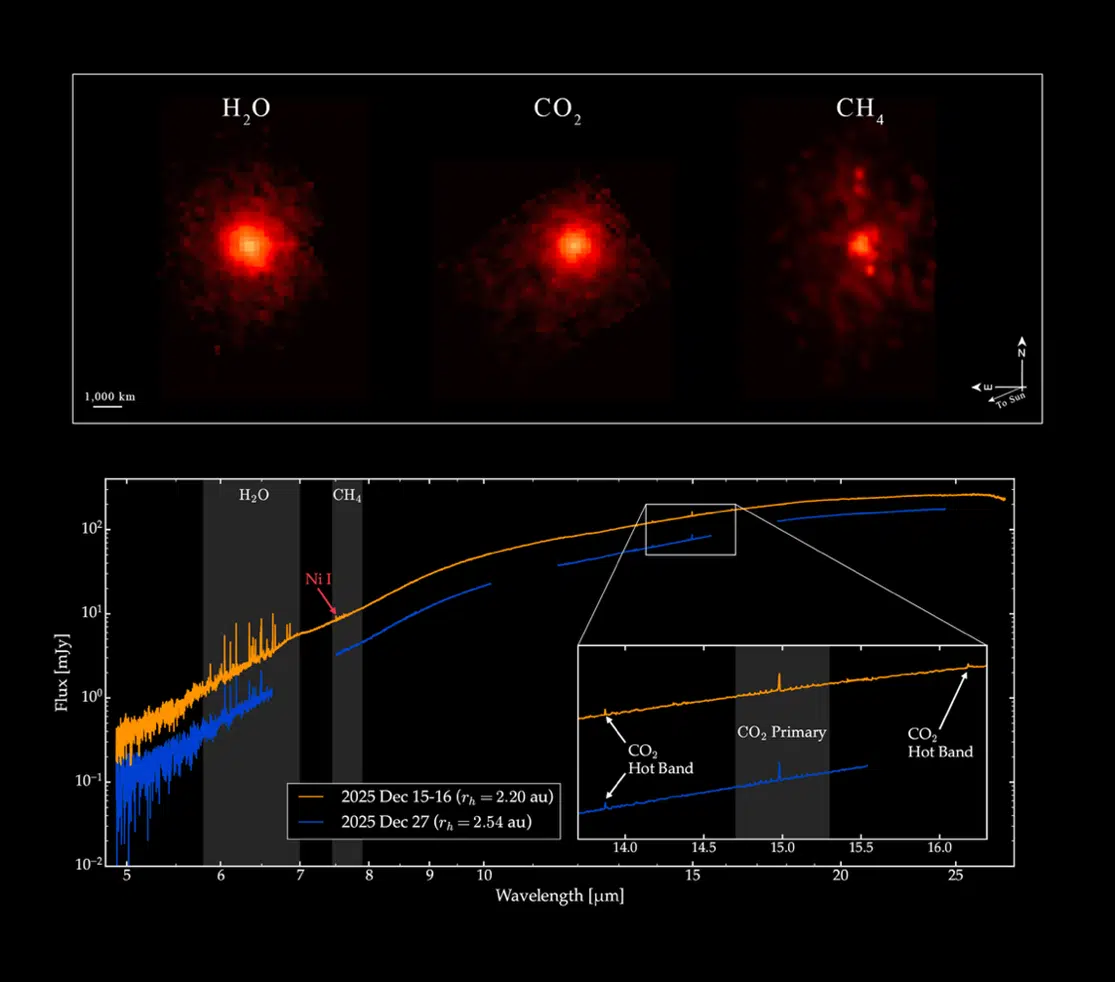
Scientists identified methane gas surrounding the comet using mid-infrared spectroscopy, a significant NASA discovery because methane is highly volatile and can rapidly undergo thermal sublimation. Researchers believe the methane remained buried beneath the comet’s surface and was shielded from solar heating until the object’s close approach to the Sun warmed deeper layers of ice.
In most of the known comets in the solar system, there is a high ratio of water compared to methane content. There have only been a few comets studied prior to this one that had these similar characteristics. Comet 3I/ATLAS was different. Scientists found that it had unusually high methane compared to water, which is rare. This kind of chemical mix is unusual and has only been seen in a few comets before.
In addition to methane, Webb confirmed that 3I/ATLAS releases exceptionally large amounts of carbon dioxide relative to water. The levels observed are significantly higher than those typically measured in comets that formed around the Sun.
According to researchers, the combined methane and carbon dioxide measurements suggest that 3I/ATLAS formed in a chemical environment very different from that of most solar system comets. The results point to a distinct formation history before the object began its journey through interstellar space.
As the comet moved further away from the sun, Webb tracked the change in its activity. The second observation period showed a much lower production of gas than the first period and there was a particularly large drop in the emission of water vapor. This decline in gas production is likely due to reduced solar heating, which results in less thermal sublimation of ices from the comet.
The observations were obtained with MIRI using its Medium Resolution Spectrometer operating as an integral field unit (IFU), which captures a distinct mid-infrared spectrum at every spatial pixel across a grid, enabling both molecular identification via vibrational signatures and spatial mapping of gas distribution relative to the comet’s nucleus.
The latest NASA discovery adds to scientists’ growing understanding of interstellar objects and could help researchers learn more about the conditions under which icy bodies form in planetary systems beyond our own.
These findings continue to expand our understanding of planetary chemistry. NASA Mars Research in Chemical Science Identifies Ancient Organic Compounds → Read more