




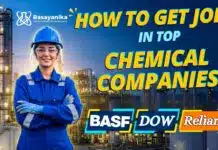
















How to Get Jobs in Top Chemical Companies Like BASF, Dow & Reliance
After finishing your Chemistry Degree, many years of studying chemical reactions, chemical mechanisms, lab techniques, etc., you are now getting ready to apply for jobs. You have opened the company careers page for companies like BASF, Dow, and Reliance Industries and feel completely overwhelmed.
The opportunities look interesting. The work appears to be important. However, there is one question that takes precedence over all the others: “What do these companies expect from me?”
This is where most recent graduates get stuck, because the transition from studying chemistry to transitioning into a successful chemical career is not just about having the knowledge. It’s about knowing and understanding how the chemical industry actually works, what companies are looking for in their job candidates, and what candidates need to do to set themselves up for success in getting a job in the chemical industry, whether they are fresh out of college or have been working in the chemical industry for a number of years.
To give you an example: If you are applying for jobs with the largest chemical companies in the world (BASF, Dow, Reliance), you will need to prove your ability to use the Chemistry you have learned in classroom settings as well as in the lab in real-world applications, where you will need to apply your ability to use Chemistry, under conditions of Scale, Safety, and Efficiency, as much as you apply it Theory.
This guide will show how companies like BASF, Dow, and Reliance think about hiring and the pathways available to fresh graduates to get into the chemical industry. It will also provide practical strategies that will help you turn yourself into a strong candidate as a chemistry graduate.
Once you know how the system works, it becomes less scary and more clever.
Understanding Chemical Careers in the Real World
Chemical careers are a large category that encompasses many industries, including petrochemicals, pharmaceuticals, materials science (such as plastics), consumer goods, and energy.
In other words:
BASF is an example of a larger company that places a lot of emphasis on innovation and sustainable practices through the use of highly engineered chemicals. Dow uses a lot of materials science, polymers, and industrial engineering in its products.
Reliance is a leader in petrochemicals, refining, and large-scale manufacturing. So while all three of these companies fall under the chemical industry umbrella, they operate in different “worlds” within the same overall industry.
- BASF = Research and sustainability.
- Dow = Materials and industrial innovation.
- Reliance = Scale, operations, and production efficiency.
Major Job Roles in Chemical Industry
Employment in chemical industries is an area where graduates may think that chemical grads only have a limited number of opportunities. However, the reality is that many types of jobs exist for chemical graduates, given that there are so many different kinds of jobs for chemical graduates.
Key Career Categories
| Category | Roles | Industry Example |
| Research & Development | R&D Scientist, Formulation Chemist | BASF, Dow |
| Industrial Operations | Process Chemist, Production Engineer | Reliance, Dow |
| Quality & Analytical | QC Chemist, Lab Analyst | All major companies |
| Advanced / Emerging Roles | Data Chemist, Regulatory Specialist | BASF, Dow |
For example: A BASF formulation chemist would work on developing environmentally friendly coatings, while a process chemist at Reliance would work to maintain the continual operation of their refinery, which runs on a 24 hour a day, 7 day a week basis.
How Companies Really Decide
Most students believe that selection will be determined solely by marks or degrees awarded; however, it does not necessarily follow that this is true. In practice, hiring has three distinct layers of evaluation (or determination): technical competence (foundational), industrial attitude (most significant), and behavioral/adaptive capabilities.
Evaluation Layer 1: Technical Capability
- Knowledge of chemical reactions in a laboratory setting
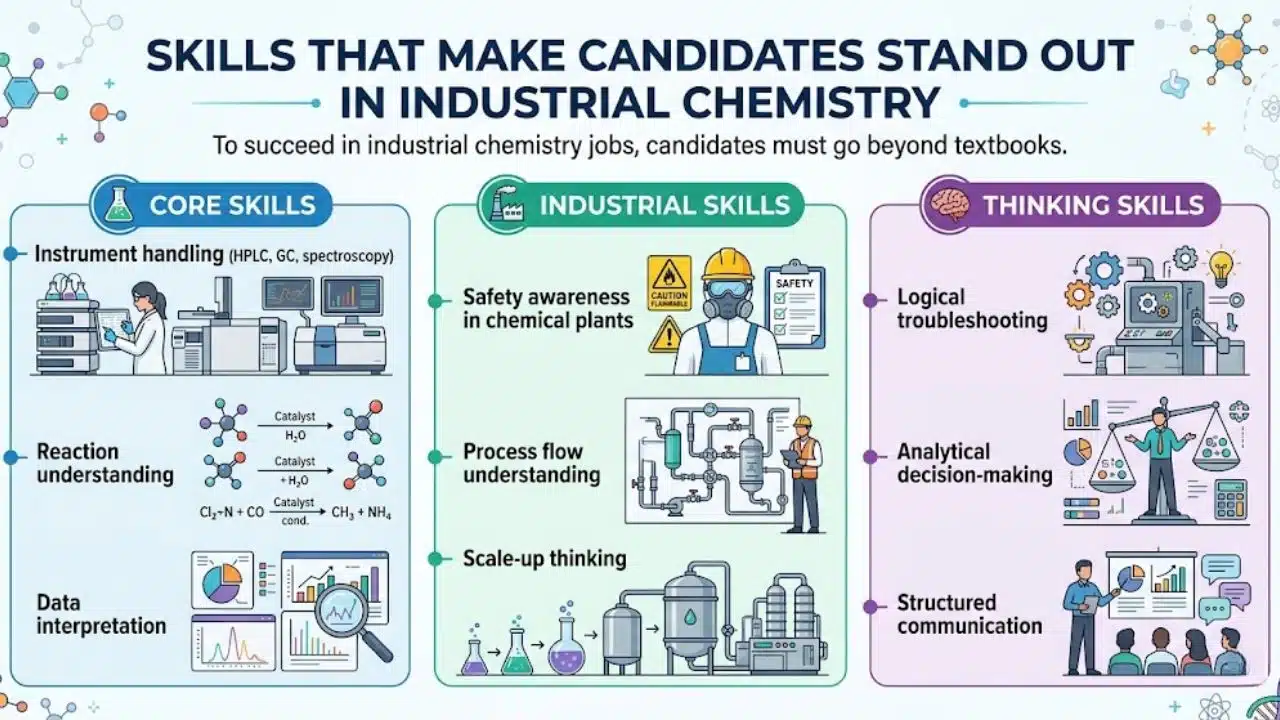
- Familiarity with analytical methods/instruments such as HPLC, GC, UV, and IR.
- Basic knowledge regarding the principles of processing chemicals.
Evaluation Layer 2: Industrial Attitude
- Can you think creatively about scale?
- Do you have an understanding of safe working practices?
- If there are constraints (time, material), can you troubleshoot them?
Evaluation Layer 3: Behavioural/Adaptive Capabilities
- Ability to work well with others
- Ability to communicate effectively in technical environments
- Ability to learn quickly when entering an industrial environment.
An example of this is: A large chemical company does not hire someone who can simply create recipes for food; they will employ someone who is able to manage a busy kitchen of a popular restaurant during peak hours effectively.
Company-Specific Hiring Focus
Each company will have its own culture; therefore, you need to know the company’s culture in order to be successful in your job search.
| Company | Core Focus | Preferred Talent |
| BASF | Innovation & sustainability | Researchers, R&D chemists |
| Dow | Materials & industrial applications | Process & application scientists |
| Reliance Industries | Petrochemicals & large-scale production | Engineers, plant chemists |
- BASF is like a scientific innovation lab on a global scale
- Dow is like a materials engineering workshop powering industries
- Reliance is like a non-stop industrial city running chemical operations 24/7
How Freshers Enter Chemical Careers
There Are Multiple Routes To Enter Chemical Careers As A New Graduate, So It’s Best To Understand All Available Options And Utilize More Than One When Attempting To Get Into This Field. The Path Of Most Success For New Graduates Seeking Employment Within The Chemical Industry Is To Utilize Six Distinct Entry Points:
1. Campus Placements
Campus recruiting is probably the most structured way to start your career, especially in India. Some of the best-known companies to conduct on-campus recruiting include Reliance and other similar organizations. The primary basis upon which you will likely receive a job offer is based upon your academic performance, basic technical knowledge, and performance during the interview process. Keep in mind that you are likely to find that you can only participate in the on-campus recruiting process through a limited number of educational institutions (usually only the ones listed on the company’s career website).

- Internships (A High-Impact Way To Get Into A Chemical Career)
One great way to break into a potentially good career in the chemical industry is through an internship. Many employers, such as BASF, Dow Chemical, and others, use internships as a talent pipeline to identify candidates for potential full-time employment.
Internships have many benefits:
- You will have hands-on laboratory or industrial experience.
- You will have practical experience with various manufacturing processes.
- You will have the opportunity to showcase your problem-solving skills in real-world situations.
The selection process for many hiring companies will be greatly influenced by whether or not you have internship experience.
- Graduate Training Programs or Other Structured Entry-Level Programs Offered By Major Companies
- Many of the largest employers in the chemical industry have structured training programs for new graduates (i.e., Graduate Engineer Trainee (GET) roles and other technical entry-level training programs).
These programs are designed to train candidates in real industrial environments and assess their learning ability, adaptability, and technical foundation. They are ideal for freshers looking for guided career growth.
- Direct Applications (Career Portals)
The most common method of obtaining employment is direct through company websites; nevertheless, it is also one of the most competitive methods. Companies such as BASF, Dow, and Reliance Industries use Applicant Tracking Systems (ATS) to screen resumes based upon predetermined criteria before a candidate is invited to interview.
To successfully get an interview through direct applications, you need to:
- Tailor your resume to each individual job role.
- Demonstrate your relevant laboratory skills, experiences, and equipment usage.
- Utilize keywords that are specific to the job description in order to be selected as a viable applicant by the ATS.
- Referrals and Networking
Referrals are among the most effective, yet frequently disregarded, pathways to employment. By networking with individuals in your desired professional field via LinkedIn, alumni, or industry events, you may greatly enhance your chances of getting shortlisted.
In many situations, and particularly when working with companies such as Reliance Industries, utilising a referral can circumvent the initial screening process and bring your application package directly to the attention of recruiters.
- Walk-in and Off-Campus Drives
When seeking industrial chemistry-based employment opportunities in manufacturing/production related roles, walk-in interviews are still a valuable resource. Numerous large chemical/petrochemical corporations provide walk-in interviews.
Insomuch as they provide:
- Rapid hiring processes;
- Immediate opportunities for interviews;
- Face-to-face interaction with a recruiter.
There is no “best” approach to securing employment within the chemical industry. The best strategies involve combining all potential avenues of employment with the following formula:
Internships + Networking + Targeted Applications = Higher Rate of Success.
By implementing this multi-path approach, new graduates can greatly increase their likelihood of securing employment.
Hiring Process Explained Simply
Applying to companies like BASF and Dow may have some variations, but they will generally go through quite similar processes that contain the following steps:
Step 1 – Application and Resume Screening
Put in your application either through an online career portal or a referral. Your resume will then be reviewed through the company’s ATS (Applicant Tracking System).
Shortlisted candidates will be selected based on:
- – Relevant experience and skills
- – Internship/Project history
- – Keyword matches.
Step 2 – Technical Interview
A technical interview will assess your core knowledge in chemistry and ability to solve problems.
Interview questions will be based upon:
- Organic Chemistry
- Physical Chemistry
- Analytical Chemistry
- Instrumentation / Lab Techniques
- Conclusion of Tech Interview – ability to demonstrate core knowledge and concepts in Chemistry
Step 3 – Practical / Problem-Solving Round
In this step, you will be asked scenario-based questions to establish how you would apply your knowledge in an industrial setting….
Examples of the questions:
- If a reaction yield dropped suddenly in a production plant, what would you do?
- What suggestions would you provide to improve the efficiency of a polymer production process?
The conclusion of the problem-solving round is to evaluate your thought process when compared to your answers.
Step 4 – HR Interview and Cultural Fit
Assessing your:
- Communication Skills
- Teamwork
- Ability to Adapt
- Motivational level to work within a professional environment
Step 5 – Final Selection and Offer
Final Evaluation will take place based on the subsequent four steps, and offers will be made based on…
- Technical Abilities
- Problem-Solving Skills
- Cultural Fit
While applying to companies such as BASF and Dow, many candidates find that the interview process is more reflective of what actually takes place in a laboratory vs. being an assessment of their theoretical knowledge via textbook exams.
The reason for this is that while theoretical knowledge is a must, the way you apply that theoretical knowledge in a laboratory setting and your thought processes used to do so are of much greater value than your textbook answers.
Example:
If a reaction fails, a strong candidate doesn’t just say “it didn’t work”; they analyze temperature, pressure, solvent, and catalyst variables systematically
Typical Student Errors
Candidates often fail because they incorrectly plan, rather than because of a lack of knowledge.
Common errors made by candidates include using the same generic resume and cover letter for all companies, not including an internship or other forms of relevant experience, and not researching specific focuses for companies prior to applying for positions.
Understanding supports examples of what the applicant is trying to accomplish. Think about a time you applied for 3 different types of sports with no additional training; therefore, your chances of being accepted were decreased by the number of applicants for each sport.
Chemical Career Outlook
Innovation, sustainability, and digital transformation will all continue to shape chemical careers well into the future of chemicals. BASF is producing new green types of chemistry; Dow continues to promote material science innovation across all types of industries; and Reliance Industries continues to automate and streamline their product processes through automation. Due to these trends, the future of chemistry is becoming increasingly interdisciplinary and incorporates not only chemistry but also other fields related to chemistry, such as artificial intelligence and sustainability. Therefore, the chemist of the future will not only know how to perform laboratory work but will also consist of multiple disciplines and possess problem-solving abilities within the scientific and technological fields.
Finding Successful Chemical Careers
Becoming successful in a chemical career is not simply about being the “most academically accomplished student in class”; rather, finding a successful chemical career requires preparation as an industry-specific thinker. Whether you know what BASF, Dow, and Reliance mean when they say “Think Differently” or align your skill set with theirs and gain sufficient experience through internships and/or projects can lead to success in the chemical industry at a high level, but through strategic means as well.