


































Scientists Built a Framework That Literally Traps Water From Air
The University of Iowa has just released a potentially groundbreaking discovery that could contribute to alleviating future global water shortages; The University of Iowa scientists are creating a new type of chemical material which they say will allow them to “capture and store” water from the atmosphere, making use of ultraviolet (UV) light. This research demonstrates the potential for a new technique of harvesting water from the atmosphere through the use of a specially designed (responsive) metal-organic framework (MOF) which will alter shape when exposed to UV light.
The authors published their work in the Journal of the American Chemical Society and showed that through an external stimulus (exposing the MOF to UV light), the MOF is able to absorb atmospheric water molecules using only energy produced by the light used to trigger the structural change. The authors believe that this discovery may lead to the development of energy-efficient methods of harvesting clean drinking water in areas that suffer from a lack of water.
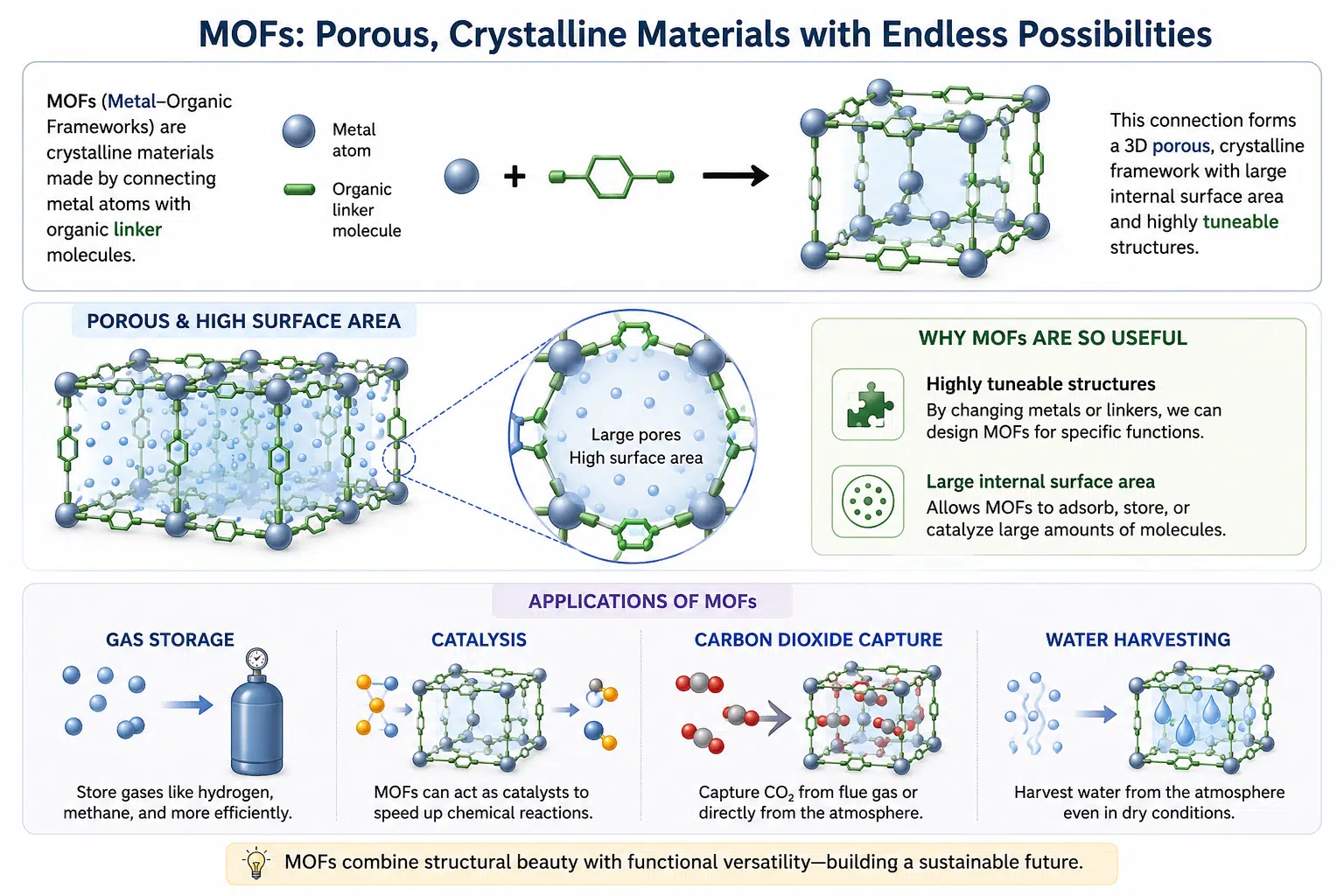
MOFs are porous, crystalline materials containing metal atoms and “linker” organic molecules formed by connecting the metal atoms together. The development of MOFs as useful materials has occurred over approximately the last two decades, and scientists now recognize their great potential as materials suitable for use in gas storage, catalysis, capturing carbon dioxide from the atmosphere, and harvesting water from the atmosphere; as such, materials possess highly tuneable structures and large internal surface areas.
Researchers at the University of Iowa developed a metal organic framework in the course of their research that has a novel feature. This material, which did not originally have sufficient pore size or cavity structure to absorb moisture, could become fully functional as a storage medium for water through the application of ultraviolet (UV) radiation. The use of ultraviolet (UV) radiation altered the arrangement of the molecular linkers and resulted in an internal rearrangement of the crystal structure that changed the arrangement of the linkers from a parallel orientation to an “X” shaped orientation, creating small voids within the framework of the crystal lattice where water vapor existed in the surrounding air would have entered and been held.
“Our research has shown that there is a mechanism to capture and store water utilizing only solar energy,” said Leonard MacGillivray, one of the lead researchers in this project.
The water storage phenomenon was discovered during the analysis of the crystal structure through x-ray diffraction and the detection of moisture within the newly formed voids of the crystal at the time of exposure to UV radiation.
Under laboratory conditions, researchers estimate that the material can also hold water that is nearly equal to 5% of its weight. Although this may appear to be a relatively small amount, scientists believe that due to its self-assembling nature, the MOF has the potential to be scaled in size to store larger quantities of water over time.
One of the most interesting aspects of this development is the intelligent harvesting of water. Conventional systems operate continuously by collecting moisture from the air, whereas the MOF only collects water when the material is triggered by a light source. The UV light produced from the sun will always be available to trigger the MOF, and thus it will use very little (or no) outside energy sources.
The research illustrates how important advanced materials chemistry will become in order to overcome environmental challenges. As climate change, the increase in population, and the increasing demand for fresh water continue to exert pressure on the world’s freshwater supply, new atmospheric water harvesting technologies are becoming increasingly important.
The United Nations projects that by the year 2050, an estimated 5 billion people will be impacted by water stress or water scarcity. Researchers believe that new light-activated metal organic frameworks may one day allow us to collect water in arid and water-limited regions using sustainable methods.
The current research serves as a proof-of-concept study, and scientists acknowledge that additional work is needed before practical deployment becomes possible. The team used cadmium-based components during the experiments and is now investigating safer and less toxic alternatives for future versions of the material. Researchers also plan to improve the framework’s water uptake capacity and evaluate its performance under real-world environmental conditions.
Still, the findings represent an important advancement in water harvesting research and demonstrate how responsive metal organic framework materials could help shape future clean water technologies