
































Table of Contents
Basics of Petrochemical Chemistry for Students and Professionals
Look around you for a moment. The phone in your hand, the chair you are sitting on, the clothes that you are wearing, and even the packaging of your food all have one thing in common… Still wondering? Yes, you definitely got it right, they are all connected to petrochemicals. These materials can be called our support systems in day-to-day life, as they help us every day. In this modern era, most of us use and are surrounded by petrochemicals and their products, yet fail to recognize them thoroughly.
It is highly essential for us to understand that once we start exploring subjects beyond our textbooks and start learning and thinking outside the box, we can learn things in much interesting ways.
This article aims to provide insights into Petrochemicals, their basics, and how students and professionals can develop skills to build a strong foundation.
What Are Petrochemicals?
Let us first understand the basic definition of Petrochemicals. They are chemical substances that are produced from crude oil or natural gas. Unlike the fuels, which are mainly used in producing energy, petrochemicals are used as raw materials to manufacture various other products. And they have gained popularity because most of them are being used to produce products that are highly essential to our daily lives.
Researchers have studied in detail and found that the petrochemicals are mainly made up of Hydrogen and Carbon. These are the organic compounds that are produced through various chemical reactions. The end products of such reactions yield substances such as plastics, synthetic fibres, rubber, detergents, and so on. In many cases, we can observe that even medicines are produced through them.
In simple terms, petrochemical chemistry focuses on how raw fossil resources are transformed into useful materials that industries depend on every day.
Origin of Petrochemicals:
The very first step in manufacturing petrochemicals is extracting crude oil and natural gas from the earth’s crust. Followed by refining these raw materials in refineries and petrochemical plants.
The important steps are mentioned as follows;
- Distillation: Here, the crude oil is separated into different fractions. This step helps in producing various byproducts that are beneficial to mankind as well.
- Cracking: the aim of this step is to break down the large chunks of hydrocarbon molecules. They are broken down into simpler and smaller substances. Where large hydrocarbon molecules are broken into smaller ones
- Catalytic processes: This step helps in controlling the reaction speed as well as aims to increase the efficiency of the process.
From these steps, basic chemical building blocks such as ethylene, propylene, benzene, and xylene are produced. These are often called “primary petrochemicals”. As the name suggests, with the help of these primary petrochemicals, one can manufacture other types.
Important Chemical Concepts:
To understand petrochemical chemistry and the petrochemical industry, a few core chemical ideas are essential. These ideas are taught at the undergraduate level but are applied on a very large industrial scale.
A few of the crucial reactions are as follows;
- Polymerization: One of the important reactions that helps is joining the smaller molecules to produce substances that are in high demand in the industry.
- Hydrogenation: This process is crucial and mainly helps in increasing the stability of the chemical compounds.
- Alkylation and reforming: This process is specifically used for creating aromatic compounds.
- Catalysis: One of the highly essential processes. This helps in reducing the time consumed during chemical reactions and thereby ensures that the development processes are faster and more selective in nature.
These reactions explain how simple hydrocarbons are turned into complex materials. This is why petrochemical chemistry is a perfect example of how theoretical chemistry meets real-world applications.
Petrochemical Products in Our Daily Life:
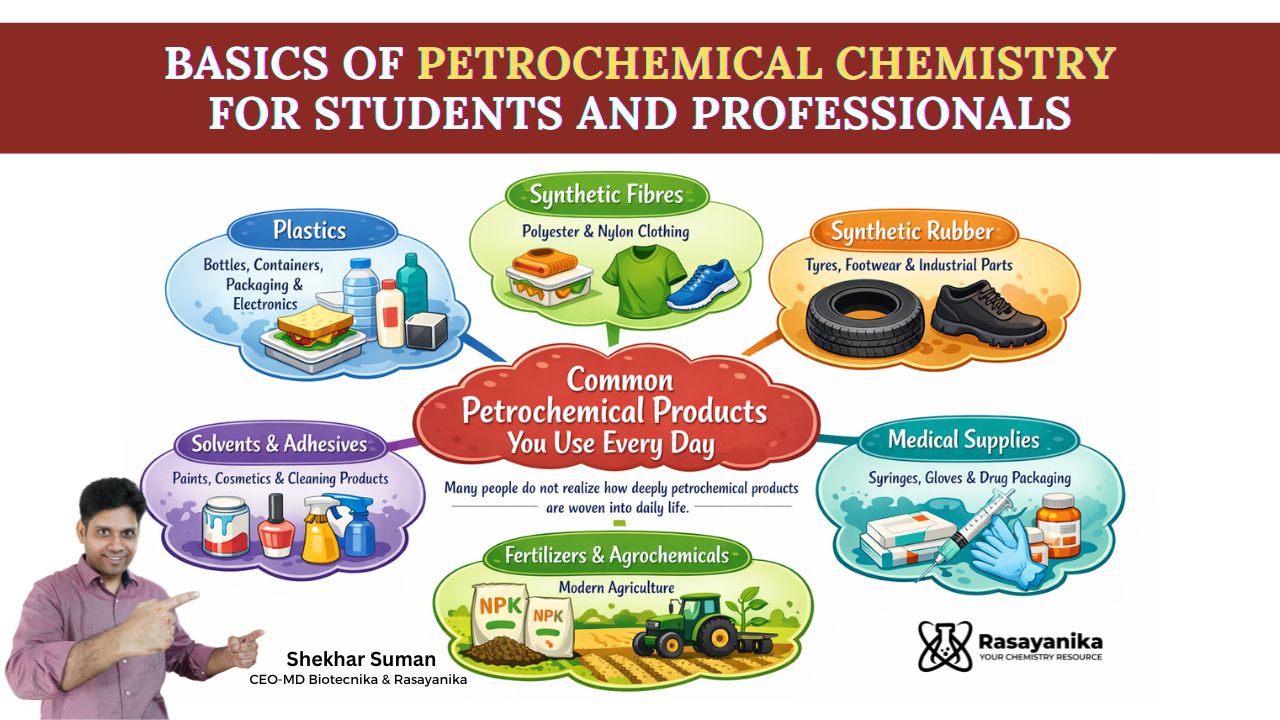
Many people us do not realize how deeply petrochemical products are woven into our daily lives. Some common examples include:
- Plastics are the most used and observed products. Be it the bottles we use, containers, packaging, and electronic items, we see plastics everywhere.
- Synthetic fibres such as polyester and nylon are used in clothing.
- Synthetic rubber is used in tyres, footwear, and industrial parts.
- Solvents and adhesives are mainly used in paints, cosmetics, and cleaning products.
- Fertilizers and agrochemicals that support modern agriculture.
- Medical supplies such as syringes, gloves, and drug packaging.
All of the above-mentioned examples show that without petrochemicals, modern healthcare, transportation, construction, and communication systems would struggle to exist in their current form.
Global Importance of Petrochemicals
The petrochemical industry is one of the largest chemical sectors in the world. It supports manufacturing, construction, agriculture, healthcare, and technology industries across countries.
Globally, petrochemical production runs into hundreds of millions of tonnes every year. Asia, especially China and India, is experiencing rapid growth driven by rising demand for plastics, textiles, and consumer goods. At the same time, industries in Europe and other regions are restructuring to stay competitive and reduce environmental impact. This makes petrochemicals not just a chemistry topic, but also an economic and strategic one.
Career Opportunities
For students and professionals, petrochemicals offer a wide range of career options. Chemistry graduates, chemical engineers, and materials scientists are all needed across different roles.
Some common career paths include:
- Process and Production Chemistry
- Quality Control and Analytical Roles
- Research and Product Development
- Safety, Health, and Environmental Management
- Operations and Supply Chain Roles
With new technologies and sustainability goals shaping the future, demand is also increasing in areas linked to green chemistry and recycling. This has strengthened the role of chemical recruitment, especially for candidates who understand both chemistry fundamentals and industrial applications.
Environmental Challenges and the Future
While petrochemicals are essential, they also raise serious environmental concerns. Some of the most common challenges include plastic waste, greenhouse gas emissions, and pollution. They are considered a major global challenge linked to petrochemical production and use.
Because of this, the future of the petrochemical industry is changing. Companies are investing in:
- Recycling and circular economy models
- Bio-based and renewable chemical feedstocks
- Cleaner production processes
- Energy-efficient and low-emission technologies
For students and professionals, this shift creates new learning and career opportunities at the intersection of chemistry, sustainability, and innovation.
Understanding petrochemicals is not just about learning reactions and formulas. It is about seeing how chemistry shapes everyday life, global industries, and future technologies.
For students, petrochemical chemistry builds a strong foundation for industrial and applied chemistry careers. For professionals, it offers a pathway to work on real-world problems that matter, such as materials, energy, sustainability, and economic growth.
As industries evolve, a clear understanding of petrochemicals will remain a valuable skill, opening doors across science, manufacturing, and innovation-driven careers.