






























Synthegy: The New AI in Chemistry Tool Helping Chemists Build Molecules
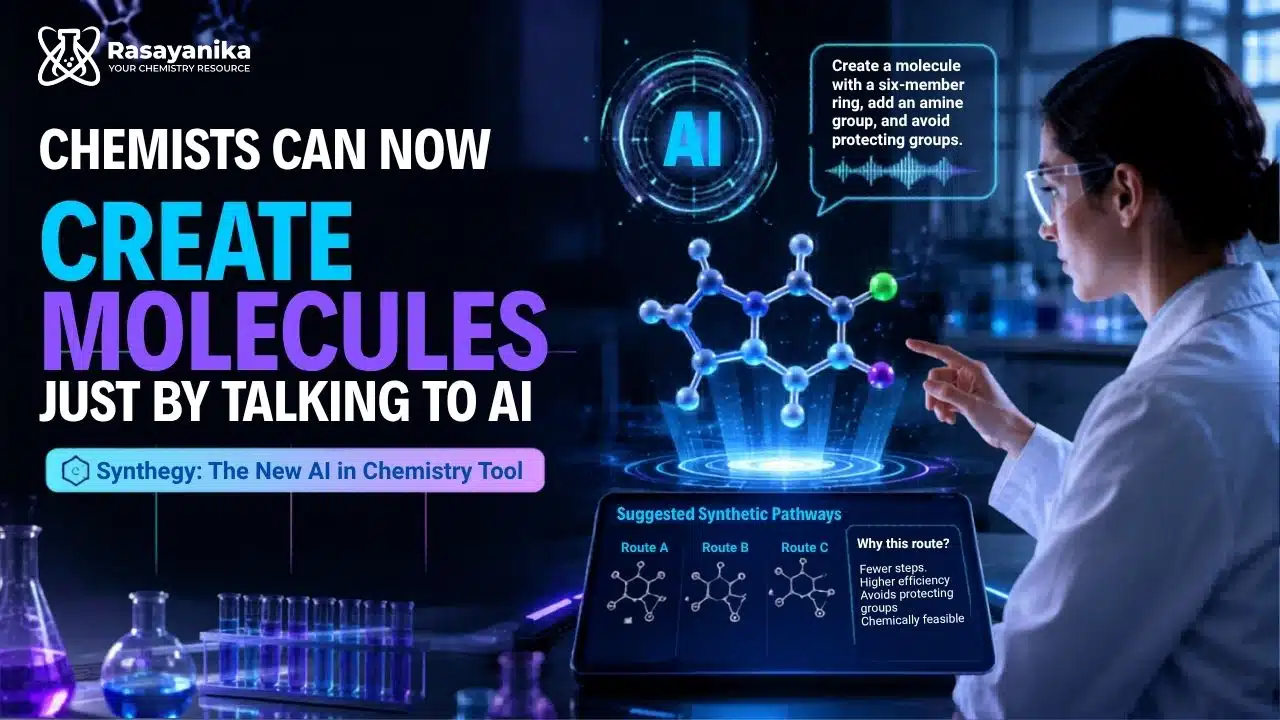
Scientists have created a new AI system that helps chemists design molecules just by describing what they want in simple language. This breakthrough in AI in Chemistry could make it much easier and faster for scientists to create new medicines and advanced materials. The system, called Synthegy, was developed by researchers led by Philippe Schwaller at EPFL.
The creation of new molecules poses a challenging job for chemists alike. There are numerous reactions that chemists must plan carefully, so that they are able to combine them in the future, and ultimately create a final product (e.g., a new medicine or advanced materials). One of the most difficult aspects of developing a new molecule is called “retrosynthesis.” In this approach, a chemist will begin with the end molecule and work backward by identifying all smaller components and chemical reactions that will form the desired final product
There are also many decisions associated with this process. Chemists will have to select appropriate building blocks as well as decide at what point in the development of the molecule it is necessary to create rings, and if certain portions of the ring must be protected from other reactions during that period. Computers can analyze many more things when searching through the millions of possible combinations of building blocks, but they still cannot evaluate them or compare them strategically as efficiently as an experienced organic chemist would know how to do.
Another difficult area is understanding reaction mechanisms. These explain how reactions happen step by step through electron movement. Knowing these mechanisms helps scientists predict reactions, improve results, and avoid wasting time and money on failed experiments. Existing computer tools can suggest many possible reaction pathways, but they often cannot identify the most realistic ones. Researchers believe advances in AI in Chemistry can help solve these problems.
Synthegy uses large language models, or LLMs, in a different way. Instead of directly creating chemical structures, the AI acts like an assistant that evaluates and guides existing chemistry software. The system combines normal search algorithms with AI that understands chemical instructions written in everyday language.
For example, a chemist can tell Synthegy to form a certain ring early in the process or avoid unnecessary protective steps. The software then creates many possible reaction pathways. Each pathway is turned into text, and the AI reviews and scores how well it matches the chemist’s instructions. The system also explains its reasoning, helping scientists quickly find the best options. This shows how AI in Chemistry can support scientists in making better decisions faster.
Synthegy can also study reaction mechanisms. It breaks reactions into small electron movements and checks different possibilities. The AI evaluates which steps make the most chemical sense. Researchers can also add extra details, such as reaction conditions or expert ideas, to improve the analysis.
In tests, Synthegy successfully found pathways that matched complicated instructions. In a double-blind study involving 36 chemists and 368 evaluations, the chemists agreed with the system’s choices about 71.2% of the time.
The researchers say the goal is not to replace chemists but to support them. By allowing scientists to describe goals in plain language, Synthegy could speed up drug discovery, improve reaction design, and make advanced tools easier to use. Experts believe AI in Chemistry could play a major role in the future of scientific research and medicine development.