

































Table of Contents
Computational Chemistry & Cheminformatics: Tools, Careers, and the Research Shaping the Future
With the advent of science and technology, we can observe that almost all fields in science are transforming at a much faster rate than before. The same applies to the Chemistry field as well. One can observe the drastic shift wherein we can realize that once thought just lab bench work and working just with test tubes and flasks has transformed. Most of the research and careers need the help of computational tools and AI to get the results in a much faster way.
This not only includes designing those life-saving drug molecules but also includes powerful tools and techniques to ease the work. This acts like a supporting system for researchers in enabling faster results. AI indeed makes us work smarter, faster and better. It also enables providing brainstorming and innovative research in a quicker way.
Cheminformatics helps in managing the data as well as analyzing the large data sets. This in turn helps in making th research faster, innovate further, and become efficiently wiser. Together, these fields are shaping the future of chemical sciences. By doing so, they are opening exciting career opportunities for students and professionals.
This article provides you with those insights that are essential to understand what computational chemistry really is. Will also discuss the various tools researchers are using. Finally, you will also understand the career paths and latest trends in chemistry.
What Is Computational Chemistry in Simple Terms?
Computational Chemistry is one of the branches of chemistry that uses computers to understand how molecules behave. Instead of performing every experiment in a laboratory, scientists can now create mathematical models that describe atoms, electrons, and chemical reactions. These models help researchers understand the molecules in a faster way. It helps them predict what molecules will look like. How stable that molecule can be and behave under different conditions, and also, they might react with different other molecules.
The main advantage is the speed and cost. Many experiments that take months in a lab can be explored in days using simulations. Researchers often use techniques such as molecular modelling and molecular simulation before real experiments, saving time and resources while reducing trial-and-error.
Scope of Cheminformatics:
While computational chemistry focuses on theory and simulations, cheminformatics deals with chemical data. It helps scientists store, organize, and analyze thousands or even millions of chemical structures and properties.
The following are the important uses of Cheminformatics,
- Researchers can easily compare large sets of molecules. With traditional methods, this would have been tedious work.
- Scientists can easily predict the biological activity of molecules as well as the toxicity of drugs.
- Identify promising compounds quickly.
One of the widely used applications includes drug discovery, materials science, and environmental chemistry. All of these work where data size and complexity are growing rapidly.
Essential Tools Used by Scientists
As we advance with the support of AI, research is relying not just on the powerful software tools, but also on the insightful software tools. Their integration leads the scientists in the right direction to help in handling the larger data sets as well as designing predictions.
Quantum Chemistry Software
With the help of multiple physics-based equations, scientists are capable of understanding the structures and reaction pathways much faster. These tools, like molecular modelling, are essential in calculating the molecular energies as well. They also help in providing answers to many advanced mechanisms such as the chemical bonding and reactivity at the atomic levels.
Molecular Simulation Platforms
One of the major advantages of using tools is that they allow scientists to understand the molecular reactions. Their interaction and time movement can be studied as well. Here, the majority of the work is helpful in studying protein structures, enzymes, and membranes. In many labs, molecular simulation plays a central role in linking theoretical predictions with experimental observations.
Toolkits for Cheminformatics
Chemical data analysis frequently makes use of open-source tools like RDKit. They assist in creating molecular descriptors, comparing structures, and using machine learning to create predictive models.
Integration of Machine Learning
Computational workflows and artificial intelligence are now closely related. By combining molecular simulation with data-driven models, scientists can make predictions more quickly and accurately.
Importance of Computational Chemistry
The importance of Computational Chemistry has grown because science itself has become more complex. Modern challenges require understanding systems that are too large or too fast to study only by experiments.
Some major application areas include:
- Drug discovery and vaccine development
- Battery and energy-storage materials
- Climate-friendly catalysts
- Polymer and nanomaterial design
They are widely used in predicting outcomes even before the start of the experiment. Thereby, computational methods reduce the risk of failure and thus guide scientists to better decision-making.
Career Opportunities in This Growing Field
As we all know, there has been a high demand for skilled professionals in this field. Computational chemistry and cheminformatics are expanding possibilities and job opportunities.
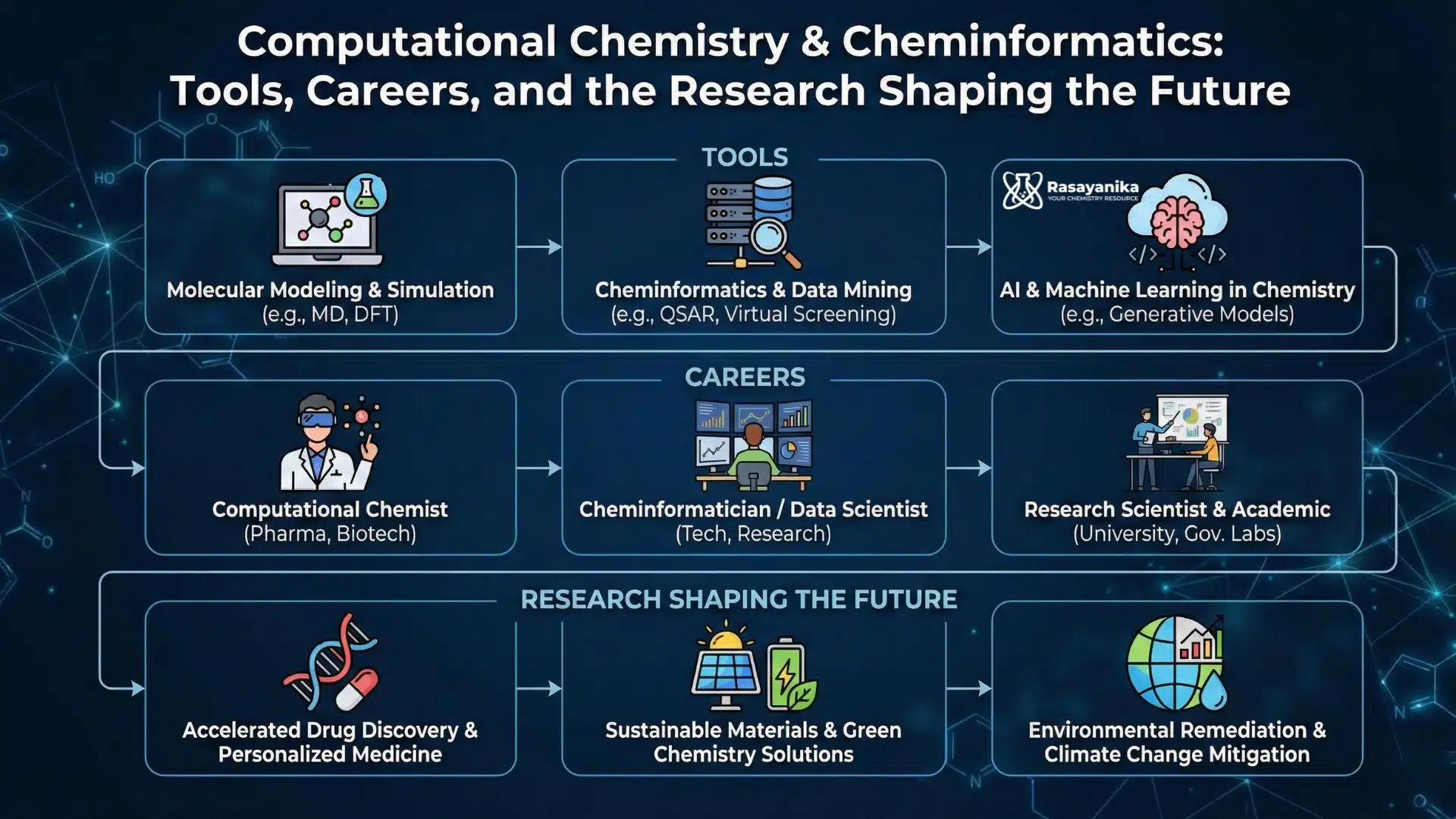
Pharmaceutical and Biotechnology Companies
These two industries are known to hire computational chemists. They are mainly recruited to design and optimize drug molecules. These roles often involve simulations, data analysis, and collaboration with medicinal chemists and biologists.
Academic Research and Teaching
University careers are a major goal for many scientists. A great number of scientists take up research positions at institutions of higher education and research facilities. In such positions, they participate in the dissemination of academic knowledge through publications, mentoring of students, and inventing new methods.
Government and National Laboratories
Experts are hired by public research institutions to contribute to projects related to energy, environment, healthcare, and national security.
Scientific Software and Data Science
A skilled professional who has expertise in both Chemistry and programming are becoming more and more essential. They are the professionals who help in scientific software development and the AI-assisted research division.
Crucial Competencies Needed
A combination of technical and scientific abilities is necessary to pursue a career in computational chemistry. A candidate should possess at least a few of the following skills;
- A solid background in physical chemistry
- Basic understanding of programming knowledge (many companies use Python)
- Understanding of simulations and data analysis
- Flexibility and ongoing education are as crucial as formal schooling as the sector continues to develop.
We can observe that the particular field of study is developing more quickly. The most cutting-edge research can be found in the following fields.
Current Research Trends:
As we can observe, this particular field of study is advancing faster and swiftly. We can see the following fields, where the most advanced research is conducted.
1. AI in Chemical Designing:
With the help of AI models, researchers can generate new molecules. Not only generate them, but they can also predict their properties. This will, in turn, help guide the experiments. This combination of data science and chemistry is accelerating discovery.
2. Faster and Smarter Simulations
New algorithms and automated workflows are making simulations more efficient and reproducible, even for very complex systems.
3. Sustainable and Green Chemistry
Computational methods are playing a major role in designing eco-friendly materials and reactions, supporting global sustainability goals.
These trends suggest that computational chemistry will only become more influential in the coming years.
Future of Computational Chemistry
In contemporary research, computational chemistry has become necessary rather than optional. These techniques will continue to direct scientific and industrial discoveries as processing capacity increases and data becomes richer.
This field provides professionals and students with higher Intellectual difficulty as well as long-term stability in the workplace. It also enables them with plenty of possibilities in a variety of industries. This not only increases the career options but also enables stronger and broader networking. It is the ideal fusion of data science, chemistry, physics, and mathematics.
We can observe how the future of chemistry and chemists will be digital, predictive, and closely related to computation. Computational chemistry and cheminformatics are revolutionizing the way we find compounds and address practical issues by fusing theory, simulations, and data analysis.
This is one of the most fascinating topics to research nowadays for anyone interested in the nexus between chemistry and technology.