
























Scientists Find Never-Before-Seen Space Molecule — A Possible Missing Link to Life
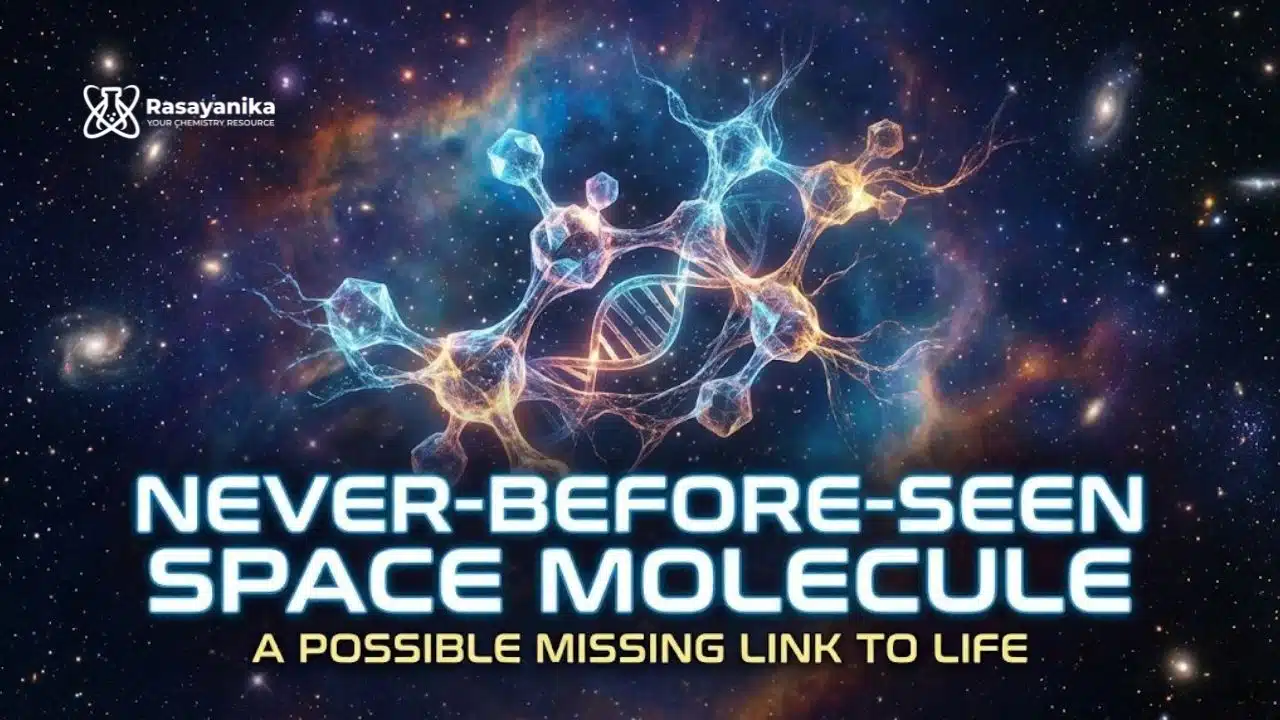
Scientists have discovered a large organic molecule in space that may help explain how life began. This molecule contains sulfur, an element that is essential for life on Earth. It is the biggest sulfur-containing organic molecule ever found in the space between stars. Researchers say this discovery fills an important gap in our understanding of how the basic chemistry needed for life formed in the universe.
Sulfur is the 10th most common element in the universe. On Earth, it is a key part of amino acids, proteins, and enzymes, all of which are needed for living cells. Scientists already knew that sulfur-based molecules exist in comets and meteorites. However, they were confused because very few large sulfur-containing molecules had been found in interstellar space, the region filled with gas and dust between stars.
“This was strange,” said Mitsunori Araki, the lead scientist from the Max Planck Institute for Extraterrestrial Physics in Germany. “Sulfur should be very common in space, but it is hard to detect.”
Earlier research suggested that sulfur might be hidden inside icy dust particles in space, rather than actually missing. The new discovery supports this idea. The newly found molecule has 13 atoms, making it the largest sulfur-bearing molecule ever detected in space. Before this, the biggest known ones had only nine atoms, and most had just three to five.
The molecule is called 2,5-cyclohexadiene-1-thione. It contains sulfur, carbon, and hydrogen, and it adds to a list of more than 300 molecules that scientists have identified in space so far. Its discovery suggests that even larger sulfur-based molecules may exist and could be found in the future.
The molecule was detected inside a molecular cloud named G+0.693–0.027, located about 27,000 light-years from Earth near the center of the Milky Way galaxy. Molecular clouds are cold, dense areas where new stars are formed. Over time, some of these clouds also form planets.
“The materials inside these clouds can later become part of planets,” explained scientist Valerio Lattanzi, a coauthor of the study. “We are trying to understand which ingredients eventually lead to life.”
To confirm the discovery, researchers first recreated the molecule in the lab. They then studied its unique radio signal and matched it with telescope data collected in Spain using the IRAM-30m and Yebes radio telescopes.
Experts not involved in the study praised the work. Professor Kate Freeman from Penn State said the discovery helps explain how complex sulfur compounds ended up in meteorites that later hit Earth. Other scientists added that finding such molecules far from our planet suggests the building blocks of life may be common across the galaxy.
“This makes the possibility of life elsewhere a little more likely,” said planetary scientist Sara Russell.
More than 50 years ago, scientists believed molecules could not survive in space. Now, discoveries like this show that space chemistry is far richer than once imagined — and that the ingredients for life may be widespread in the universe.