














Artificial Turf’s Hidden Threat: Rubber Chemicals and Microplastic Pollution Lurking Beneath Your Feet
Artificial turf is synthetic fibres that are similar to grass and have been marketed as a green alternative to natural grass for different places such as sports fields, playgrounds, and residential or public landscaping. Scientists have raised a concern that this “recycled” solution may carry a hidden environmental cost. The sunlight and the weather break down crumb rubber from old tyres by releasing a complex mixture of rubber chemicals and microplastics. This process can have fatal effects and consequences on the human population.
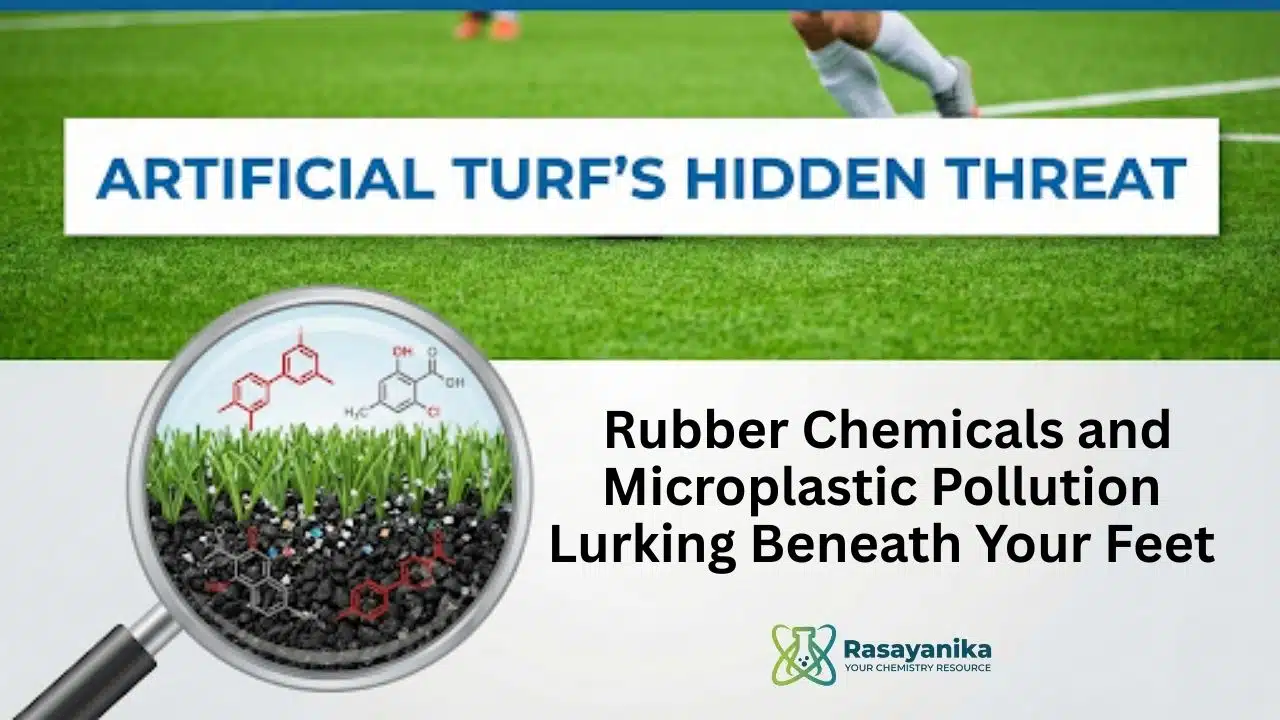
Research was conducted at Northeastern University to examine the chemical life cycle of crumb rubber, which is the black pellets used for infilling in many artificial turf fields. These are made up of recycled car tyres and contain many additives to enhance the durability of the tire, which include stabilizers, antioxidants, and other rubber chemicals.
Although the compounds used in the tyres help them to withstand the harsh road conditions, scientists say they act very differently once shredded and exposed to sunlight, rain, and air.
In this research, the team led by chemist Zhenyu Tian used a photoreactor to simulate the years of environmental exposure in a matter of months. They found that crumb rubber doesn’t break down easily. Instead, it produces at least 572 prominent transformative chemicals, many previously unknown. These substances are produced when the rubber’s additives react with oxygen, water, and sunlight, while the material itself fragments into tiny particles that contribute to microplastic pollution, which would spread into the surrounding environment. Among the most concerning chemicals was 6PPD-quinone, a transformation product of the tyre.
Previous studies show that even small amounts of 6PPD-quinone can kill juvenile coho salmon in under an hour, which highlights a serious concern about ecological risks. While the effects on humans remain uncertain, other chemicals found in the study raise immediate health concerns. 4-HDPA is an endocrine disruptor, is suspected to increase the risk of breast cancer, and 1,3-DMBA mimics the stimulating effects of amphetamines. Repeated exposure, particularly for children and athletes, could pose serious health issues.
Earlier assessments, including a 2019 Environmental Protection Agency report, suggested that chemical exposure from synthetic turf was limited. Tian warns that such evaluations may underestimate the problem. Crumb rubber remains chemically active for months or even years, producing new compounds rather than stabilizing.
The team also noticed that smaller molecules sometimes recombine into larger, more complex substances, complicating predictions about toxicity. This transformation process can take two to three years, similar to the typical replacement cycle of artificial turf, which means many fields continually renew this chemical activity.
For most of the hundreds of transformation chemicals identified, the impacts on human health and ecosystems are still unknown. Tian bluntly summarizes the uncertainty: “God knows what it does.”
What is clear from the studies is that a safe, recycled rubber surface lies in a dynamic chemical environment, the one that generates hazardous rubber chemicals, contributes to microplastic pollution, and raises urgent questions about the long-term safety of artificial turf fields. For those interested in exploring how artificial intelligence and machine learning can be applied to chemical research and safety, the AI ML in Chemistry & Cheminformatics course offers a deep dive into this advanced field.