































Table of Contents
How Food Chemists Impact the Food Industry: From Lab to Market
People nowadays care about nutrition in food more than taste. Customers check the labels first before consuming it, and nutrition and food safety bother them. Any minute information regarding food is vital, and a job role is behind this to take care of any food safety-related issues. These experts are known as Food Chemists. They work as the pillar of the modern food industry, as they use scientific knowledge to make our Food Chemistry better and safer to consume.
This guide takes you on a journey that states the power of food chemists in the food industry and how they bring them from a lab scale to an industrial one. Followed by the scope and opportunities in this career in the near future on a stable scale.
Food chemists- who are they?
Food Chemists are the ones who study food at a chemical level and the interactions that it goes through in several steps, like processing, making, and storing. Food Chemistry is all about optimizing the nutritional value, flavour, and shelf life of food.
Food Chemists do not mean only lab work. They have to collaborate with different teams, like the one that develops products, or manufacturers them, or quality checks, so that consumers can get the food with the best quality and that checks all the safety boxes.
To develop products, how Food Chemists Help
Primarily, food chemists experiment with food products by testing with new ingredients that can make its taste better, get the required texture, and maintain its optimized nutritional values.
For example, a wants to launch a product that is rich in protein content, whereas it has minimal sugar content. So, here the food chemist plays the role by analyzing and choosing several alternatives to sugar or protein bases. They take care to optimize the taste and keep it the same across all batches, yet remain stable, while following all the safety protocols. This helps in making any lab-scale product into an industrial one.
Food Chemists to ensure the quality & Safety of Food
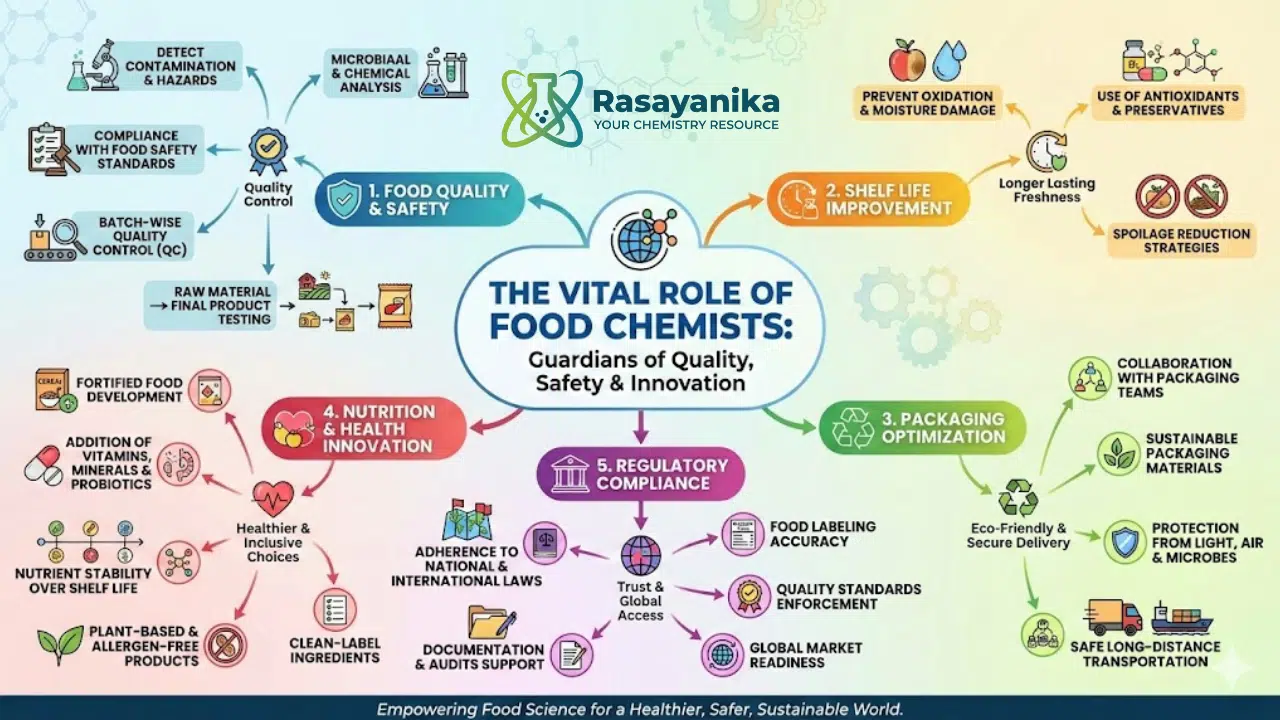
The most important aspect to address in the food industry is its safety standards. A chemist’s foremost job is to check for any contamination or hazardous substances or microbes, to detect and analyze them according to safety standards. They can make it market-ready only when they can meet all the safety protocols and regulations regarding the food.
To be a market-ready food product, QC procedures across batches are very important; hence, these chemists also carry out these procedures. Beginning with raw material checks, to ending with the final optimized products, their first priority is to ensure the top-notch quality of the end product.
Improving Shelf Life and Packaging
Achieving shelf life is one of the biggest hurdles in food chemistry, and even maintaining its quality. Shelf life is often hampered by certain reactions, such as oxidation and moisture retention. Food spoilage can be reversed by the use of antioxidants, preservatives, etc.
In this procedure, packaging is essential. To choose sustainable materials that shield goods from light, air, and microbes, food chemists collaborate closely with packaging teams. This tactic ensures food stays safe throughout long-distance transit, prolongs shelf life, and minimizes spoiling.
Supporting Nutrition and Health Trends
Nowadays, this generation of consumers is more concerned about a healthy lifestyle. Food chemists play a vital role in achieving this lifestyle by developing certain fortified foods that contain dietary supplements. Be it adding vitamins, minerals, or other probiotics supplements, etc., they make sure nutritional values remain intact throughout the product’s shelf life.
They give certain alternatives like plant-based, allergen-free, and clean ingredients ready products, which are quickly changing and building the modern food industry.
Regulatory Compliance and Standards
Every food product has to follow strict rules set by national and international authorities. Food chemists play an important role in helping companies meet food safety laws, labeling guidelines, and quality standards. They handle paperwork, check that processes are working correctly, and support the team during audits and inspections. Without their expertise, food companies would find it difficult to stay compliant and expand into global markets.
From Lab to Market: The Bigger Impact
The work of Food Chemists does not stop after product formulation. They support scale-up processes, ensuring that recipes developed in the lab can be manufactured on a large scale without losing quality. A Food Industry Career also troubleshoots production problems and optimizes costs, making products affordable for consumers.
Their contribution directly impacts brand trust, consumer satisfaction, and business growth.
Food Industry Career Opportunities for Food Chemists
The diversity of a food chemist’s job role in the food industry is vast. Food industry careers are easily achieved in various fields like manufacturing, R&D, QC, startups, etc. Several job roles are scientists to develop products, chemists for quality assurance, officers to check food safety, etc.
In the near future, this career will be one of the most stable and promising career options with evolving food security safety standards and margins. This will work as a long-term career with exponential growth.
Final Takeaways
In today’s food chemistry, food chemists play a crucial role in everything from developing new flavors to ensuring food is safe and nourishing. Their expertise aids in transforming concepts from the laboratory into goods that may be found on store shelves while satisfying customer demands and legal requirements.
A career as a food scientist offers significant growth potential and a meaningful future in the rapidly evolving food business for anyone who loves science and wants to see their work make a real difference.