

























Table of Contents
Scientists’ Advances in Hydrogels to Boost 3D Printing in Medicine for Bone Implants
Scientists at ETH Zurich have developed a new soft material that could help create personalized bone implants in the future. The material is a dissolvable hydrogel, which is soft like jelly and slowly breaks down inside the body. This development could play an important role in personalized medicine, where treatments are designed to match each individual’s specific needs.
When someone breaks a bone in a small accident, it usually heals on its own. But if the damage is very serious, or if a bone tumor must be removed, doctors often need to insert an implant to help the bone grow back together.
Today, implants are often made from pieces of the patient’s own bone, called autografts, or from metal or ceramic materials. Autografts require a second surgery to remove bone from another part of the body. Metal implants can also cause problems because they are very stiff and may loosen over time.
Professor Xiao-Hua Qin, a biomaterials expert at ETH Zurich, explains that bone is not a simple solid structure. It contains many tiny tunnels and cavities. For proper healing, living cells must move into the implant and form new bone. Because of this, biology must be part of the repair process.
Together with her team and Professor Ralph Müller, Qin developed a new hydrogel designed to copy how the body naturally heals bone.
Inspired by natural healing
When a bone first breaks, the body does not immediately create hard bone. In the first few days, a soft bruise, called a hematoma, forms. This soft material allows repair cells and immune cells to move in and receive nutrients. A fibrin network holds these cells together. Later, this soft structure slowly turns into hard bone.
The new hydrogel works in a similar way. It is made of 97% water and 3% biocompatible polymer. To make the material solid, the researchers added two special molecules. One molecule connects the polymer chains. The other starts the reaction when exposed to light.
Wanwan Qiu, a former doctoral student, developed the special connecting molecule. When laser light of a certain wavelength hits the hydrogel, the polymer chains link together and become solid in those exact spots. The parts not exposed to the laser remain soft and can be washed away.
Extremely fine and fast printing
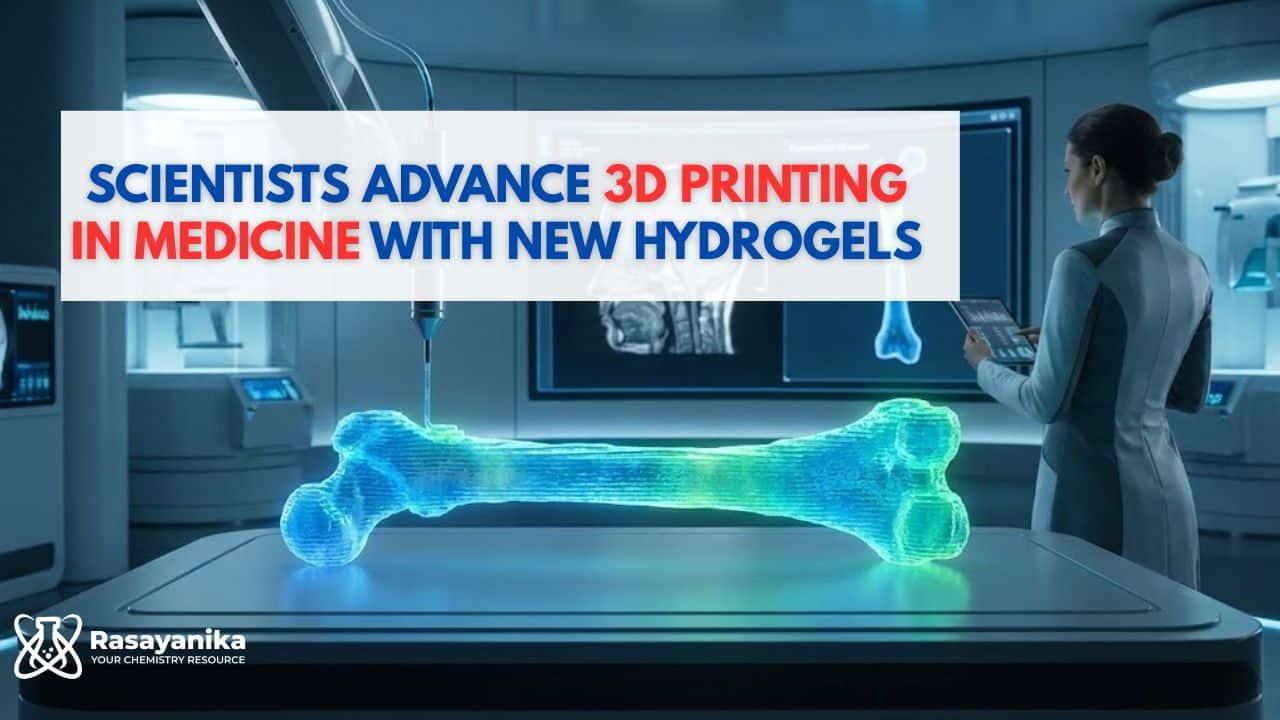
Using a laser beam, the scientists can “print” very detailed shapes into the hydrogel. This process is similar to 3D printing in medicine, where materials are shaped layer by layer to match medical needs. The structures can be as small as 500 nanometers. The structures can be as small as 500 nanometers. According to Qin, shaping hydrogels is usually difficult because they are so soft. But with the new connecting molecule, they can shape the material in a stable and very precise way.
They can also do this at very high speed up to 400 millimeters per second, which Qin says is a world record.
In their study, the team created complex structures that look like real bone, including fine networks similar to bone trabeculae. They used medical imaging as a guide.
Even healthy bone contains an enormous number of tiny channels filled with fluid. Qin explains that a piece of bone the size of a dice contains about 74 kilometers of tunnels. For comparison, the Gotthard Base Tunnel is 54 kilometers long.
Promising early results
So far, the hydrogel has only been tested in the laboratory. The results show that bone-forming cells quickly grow into the material and begin producing collagen, an important part of bone. Tests also showed that the material is biocompatible and does not harm these cells.
The researchers have patented the base material and plan to offer it to the medical industry.
Their goal is to use this hydrogel one day in hospitals to repair broken bones. If successful, this approach could become an important step forward for personalized medicine, allowing researchers to create custom bone implants using advanced hydrogels and 3D printing in medicine. The next step is animal testing, which Qin is preparing in cooperation with the AO Research Institute Davos. The team wants to find out if the material helps bone-forming cells move and if it can restore bone strength over time.