


























Scientists Discover Electric Fields Change How Water Breaks Apart
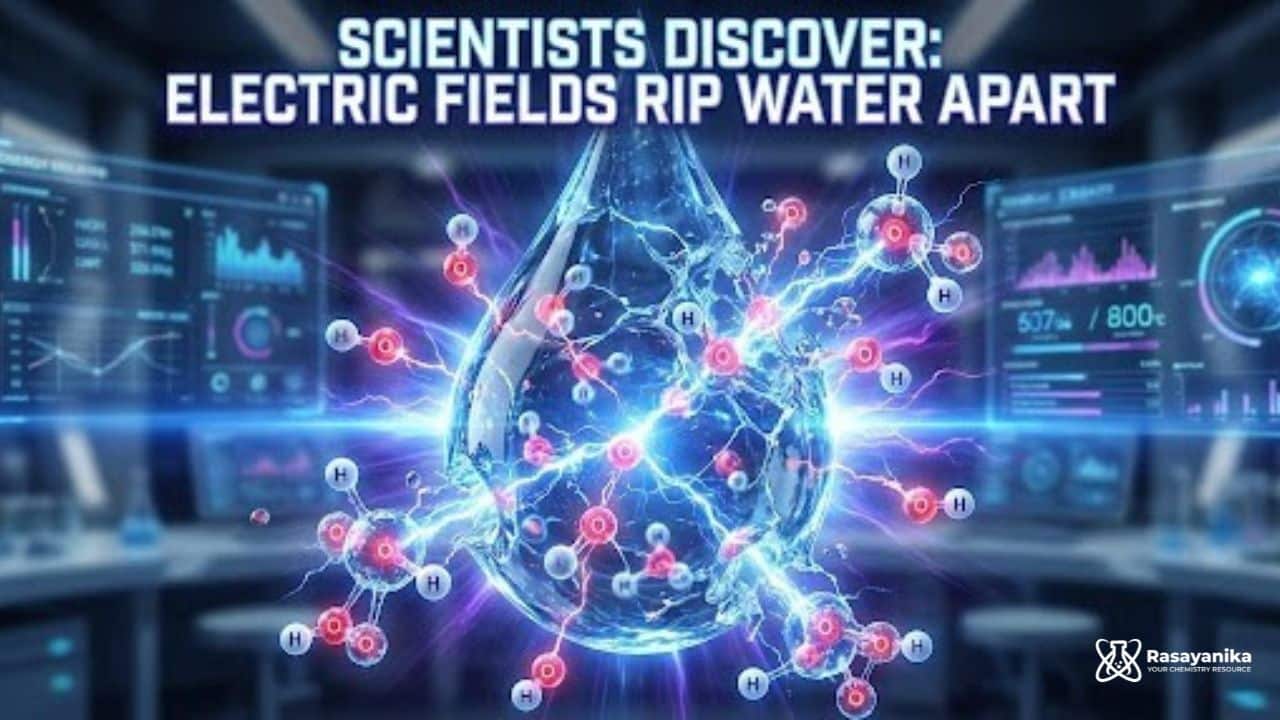
Did you know that water can behave in a strange way that we might have never thought of? Exactly, even scientists did not expect water to react unconventionally. Recently, scientists have made a major breakthrough in which they found that water can split into ions when it is subjected to strong electric fields. This discovery can be a game-changer and will be an essential part of transforming hydrogen fuel and other energy technologies to produce clean energy in the future.
The Scientists at the Max Planck Institute for Polymer Research and the Yusuf Hamied Department of Chemistry at the University of Cambridge conducted a study. This study is called the water autodissociation process, in which water molecules split normally into hydrogen and rarely into hydroxide ions. They knew how water behaves under normal conditions, so they induced strong electric fields to see how water behaves under very strong ones, the same electric fields that are found in electrochemical devices.
Nature knows one simple rule: Things naturally tend to move towards lower states of energy and become more disordered over time, which is based on entropy. A reaction can take place spontaneously on its own only if the entropy increases or if its energy is lowered.
Normally, water doesn’t split spontaneously because its energy is not decreased or lowered, or in other words, its entropy does not change. Due to this unaffected entropy, the reaction slows down considerably, but this can be changed by inducing strong electric fields.
During the experiment, they found that it is not the energy previously assumed to break the molecule, but entropy. Another Scientist, Yair Litman from the Max Planck Institute, explains that in strong electric fields, water molecules first become highly ordered. When ions form, this order is disrupted, increasing disorder (entropy). This increase in disorder actually drives the reaction, making water splitting much faster. “It’s a complete reversal of what happens without an electric field,” Litman says.
The study also found that under strong electric fields, water can become much more acidic. Its pH can drop from neutral 7 to as low as 3. This finding is an essential part of designing devices that use water splitting, such as hydrogen fuel systems.
Angelos Michaelides from Cambridge says the discovery changes how scientists should think about water splitting. “We need to consider not just energy, but also entropy, and how electric fields change water at the molecular level,” he says.
This research has the potential to improve the design of electrochemical devices and may help create better catalysts for reactions involving water. It also suggests that models of water chemistry under strong electric fields should include entropy, not just energy.
The findings were published in the Journal of the American Chemical Society in a paper titled “Entropy Governs the Structure and Reactivity of Water Dissociation Under Electric Fields” by Yair Litman and Angelos Michaelides.