

























How AI & Big Data Are Transforming Chemical Research in India
As artificial intelligence (AI) is becoming part of all our daily lives, it is no exception in Chemical Research as well. The chemical research domain is observing a substantial impact from AI technologies and is quietly undergoing a big revolution.
Earlier, most experiments were tedious and highly time-consuming; with the incorporation of AI, this has been drastically revolutionized. Most of the iterations, predicting models as well as designing drug candidates used to be through bench work. Now we can understand and observe that with the help of AI, one obtains results in a much quicker way than possible.
Now, techniques like machine learning models and data analytics help chemists design molecules, predict their reactions, and scale up processes faster and with greater accuracy.
This article will provide insights into AI in Chemistry in India, how AI & Big Data Are Transforming Chemical Research in India.
Why is AI essential in Chemistry and its Research?
As we all know, the chemical reactions are highly complex, and any slight change in the structures of reactants can lead to products that are entirely different or even not yield any products at all . Now, here is how AI plays the most crucial role: it can actually analyze data from all those numerous experiments performed earlier and provide a conclusion or reliable data on how one can proceed with the current experiment. This not only reduced the time span of the current experiment but also will help in getting better results as the researchers can gain insights into those errors and mistakes that made the earlier experiment fail or yield different results.
So the gist is that using AI in Chemical Research will reduce the burden of trial and error processes, thereby reducing the precious time of researchers.
Success story of PURE at IIT Madras:
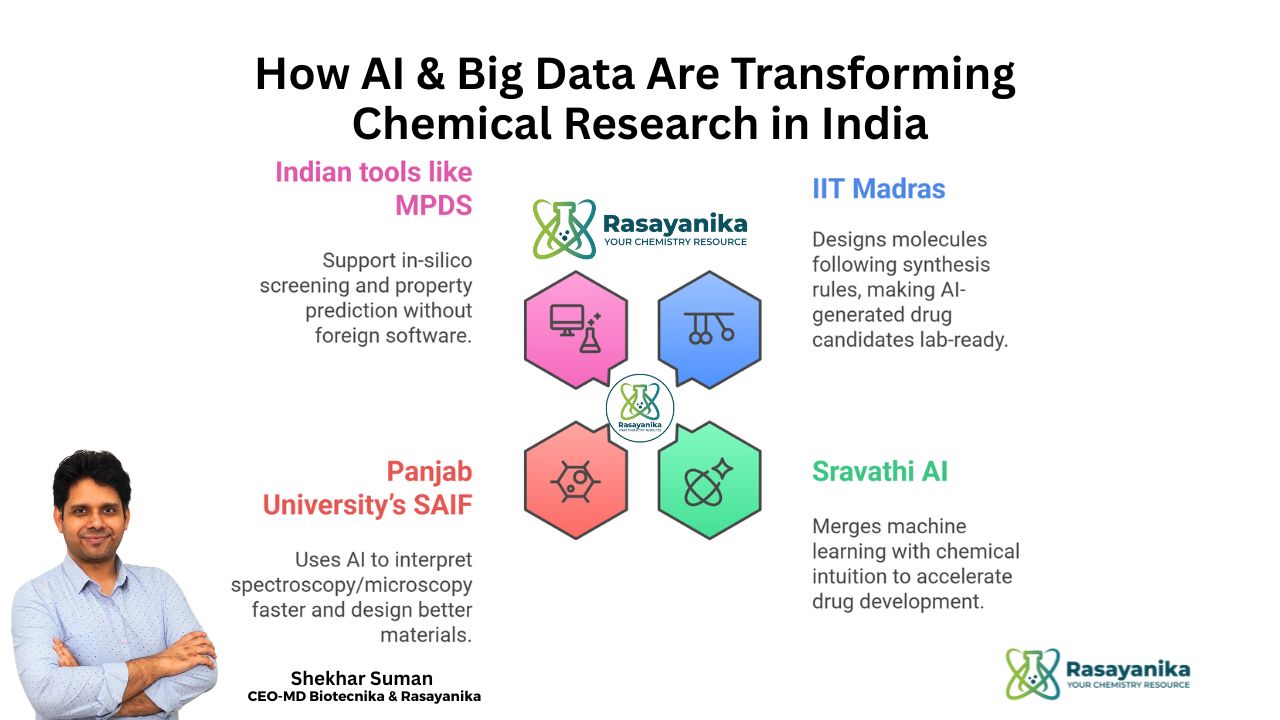
Researchers from IIT Madras created one of the most advanced AI frameworks, known as PURE (Policy-guided Unbiased Representations for Structure-Constrained Molecular Generation). This was developed in collaboration with one of the prestigious universities, the Ohio State University. The PURE is one of the most reliable AI frameworks as it proposes those molecules that can be synthesized in a real laboratory. This actually means that the major challenge between the computational predictions and practical drug discovery processes could be narrowed down extensively and one can predict the AI-based drug discoveries. The work has been widely recognized as a major leap for AI-assisted molecular design.
Startups incorporating AI into their Chemical Research:
A Bengaluru-based start-up is known to incorporate AI and help in suggesting those drug-like compounds. Saravathi AI is blending physics-based machine learning models and helping in developing those drug-like compounds. Their unique feature is that AI helps in proposing the drug candidates, and chemists are known to evaluate the results. This approach not only helps speed up early discovery but also gives Indian teams a competitive edge in fast-moving R&D programs.
SAIF initiative by Panjab University:
Moving ahead, we can also observe that Materials Science is gaining equal importance as it is showing promising results by incorporating AI technologies. Panjab University’s SAIF/CIL recently secured a ₹1 crore CSR grant as it integrates AI into spectroscopy, microscopy, and data-heavy material analysis. As Machine Learning is accelerating the workflows such as characterization, researchers are now capable of identifying the trends in a much faster way and can proceed with the experiments in a more precise way possible. It’s a clear example of how academic labs are moving toward a data-first research culture.
India’s Own Computational Chemistry Tools: MPDS
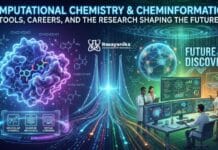
India has been building its own computational capabilities. One of the cheminformatics tools developed by Prof. G. N. Sastry and collaborators is the Molecular Property Diagnostic Suite (MPDS). This tool helps in compiling large datasets and offers predictions that can be used by researchers to help with their experiments. This is one of those predictive models that chemists can use for screening and property prediction. These platforms strengthen India’s scientific independence and ensure researchers have access to reliable, locally developed digital tools.
Industry Adoption: AI in Plants and Large-Scale Processes
AI is not just confined to research laboratories. Several chemical industries are adopting digital twins, predictive analytics, and smart process-control tools to boost efficiency.
Tata Chemicals and other players have reported improved yields and reduced time consumptions due to the incorporation of AI models. Reliance also announced plans to integrate predictive analytics into its sophisticated chemical operations. Such shifts illustrate the practical utility of AI towards sustainability and waste reduction.
Even though AI has numerous advantages on helping the resrchers and chemical companies, it also has few challenges and limitations of its own. Many labs still use instruments that don’t export data in formats suited for machine learning, and data standards vary widely. There is also a shortage of chemists who are well-versed in data science. Building training programs, encouraging open-data practices, and strengthening industry–academia collaboration are essential next steps.
If current momentum continues, India is set to see faster drug discovery cycles, materials engineered for specific performance demands, and smarter industrial plants that operate with minimal waste. The examples from IIT Madras, Sravathi AI, Panjab University, MPDS developers, and major chemical industries already show what’s possible.
India is no longer simply observing the AI shift; it’s actively shaping it. With steady investment in data infrastructure, skilled talent, and collaborative research models, the country is well-positioned to lead the next wave of data-driven chemical innovation.