


































Table of Contents
How Biostimulants Work: Chemical Pathways That Boost Plant Growth
When we talk about healthy crops and healthy farming techniques, we often restrict our thoughts to fertilizers and water. Definitely, they are essential and are the main components of farming, but there is another powerful tool that plays a crucial role in healthy agriculture. Yes, they are the Biostimulants.
They are unlike the fertilizers and nutrients we frequently have access to or use for plant growth. On the other hand, these are the molecules that indeed tweak a plant’s chemistry and its relationship with soil microbes so crops grow stronger, use nutrients smarter, and survive stress better. This article explains those core chemical pathways behind how biostimulants work, what recent studies show, and their importance in Agrochemistry.
What are Biostimulants?
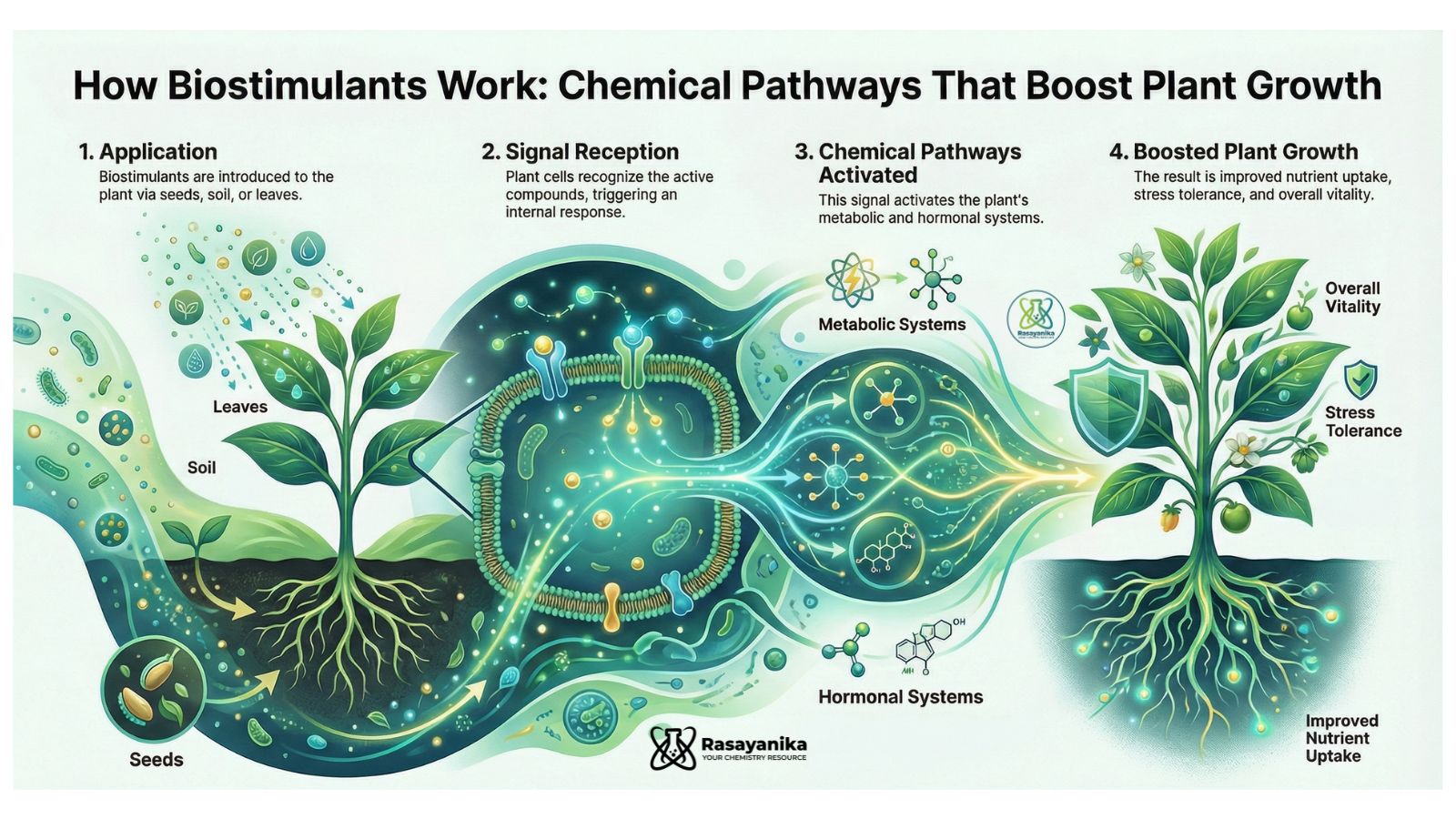
Biostimulants are substances or living organisms you add to seeds, soil, or leaves. They are definitely not like the fertilizers or pesticides. Their job is to stimulate the plant’s own processes. For example, they are helping the plants by improving root growth, boosting antioxidant systems, or recruiting helpful microbes. The European Fertilising Products Regulation (FPR) recently helped standardize this idea, making it easier to know what truly counts as a biostimulant.
Major Types and their Compositions
There are a few common groups on these product labels. Some of them are mentioned below;
- Seaweed extracts: There are tiny sugar, hormone-like, or vitamin molecules. These biostimulants act like signal molecules to enhance plant growth.
- Humic and fulvic acids: These fall under the large organic molecules category. They help in binding nutrients and influence root membranes.
- Protein hydrolysates and amino acids: As the name suggests, these are short peptides and free amino acids. This type of biostimulant can be used by plants directly. Or the compounds can also act like signaling molecules.
- Microbial products: One significant type of biostimulant is microbial products, such as bacterial or fungal extracts. That can produce hormones that can easily solubilize phosphorus or help roots take up nitrogen.
Each group contains multiple active chemicals or living compounds. Reviews from the last two years highlight that higher-plant extracts and microbial blends consistently and measurably affect plant physiology.
The Chemistry behind the effects
Even though biostimulants have a diverse origin, they all help in bringing about the necessary signalling pathways to enhance the crop yield.
- Hormone-like signaling.
Many of these extracts consist of those hormones that has the capacity to alter the signalling pathways. For example, when auxins and cytokinin-like structures are present, they aid in cell division and faster growth. These small molecules help in root differentiation and enhance by deper and more branchy root formation. This in turn helps in improving the nutrient absorption through roots. - Redox balance & antioxidants.
Plants’ stress, such as heat, drought, or high saline concentration, has a negative impact on plant growth. As they are releasing reactive oxygen species (ROS). These ROS are the main cause of cell damage in most cases. With the help of biostimulants, one can increase a particular type of enzyme, such as superoxide dismutase or catalase. These enzymes are known as the antioxidant enzymes are help in reducing cell damage. Hence, the enzymes help in protecting the plants and enabling their growth. - Better nutrient uptake.
Humic substances and some microbial metabolites change the root membrane activity. This, in turn, influences the movement of transport proteins. That often means enabling more efficient uptake of micro and macro nutrients essential for the plants. Also, they help plants use fertilizer more effectively. - Microbe–plant signaling.
Beneficial microbes produce siderophores, volatile signals, and enzymes that change how roots exude sugars and acids. This helps recruit a helpful microbiome around the root that cycles nutrients and suppresses harmful organisms. - Gene and metabolic shifts.
Biostimulants often change depending on the type of genes that are turned on. Based on the genes that are active, they can shift metabolism toward osmolyte production, such as proline, stress-protective compounds, or secondary metabolites that improve quality traits (taste, antioxidant content).
Why are scientists and industry excited?
Modern Agrochemistry is no longer focused only on making stronger fertilizers or pesticides. It is now deeply connected with understanding how plants respond to small chemical signals at the cellular level.
Multiple researchers working on agrochemistry and plant physiology are intrigued by the advantages of biostimulants. Scientists are decoding the mechanism of action of these molecules on the plant systems. They are isolating the active elements and are trying to find answers through mapping dose-responsive curves. Research is finding a way to stabilize the live microbes and signaling pathways. And the end goal is to obtain a reliable and repeatable use of these products across all different farm conditions.
From an industry perspective, biostimulants align well with the future of Agrochemistry, which balances crop productivity with environmental responsibility.
Biostimulants are natural tools that can be used in diverse ways to enhance crop yield. They are considered the most resilient and efficient tools that activate the required signalling pathways to enhance yield. Even though they have their own advantages, we cannot replace them with chemical fertilizers. One can simply choose these biostimulants at the right time and amount. They are known to show measurable success rates when used on plants under stress. As the technology advances, this field is also moving fast: more mechanistic studies and clearer regulations are making these products easier to trust.
Key Takeaways:
- Plant Biostimulants: These are the products applied to plants or soil to enhance natural processes that improve nutrient use, stress tolerance, or crop quality.
- Plant growth stimulants: These are a broader, informal term sometimes used interchangeably with biostimulants, though not all stimulants meet strict regulatory definitions.