






























Product Chemistry and Materials Science: Design to Use
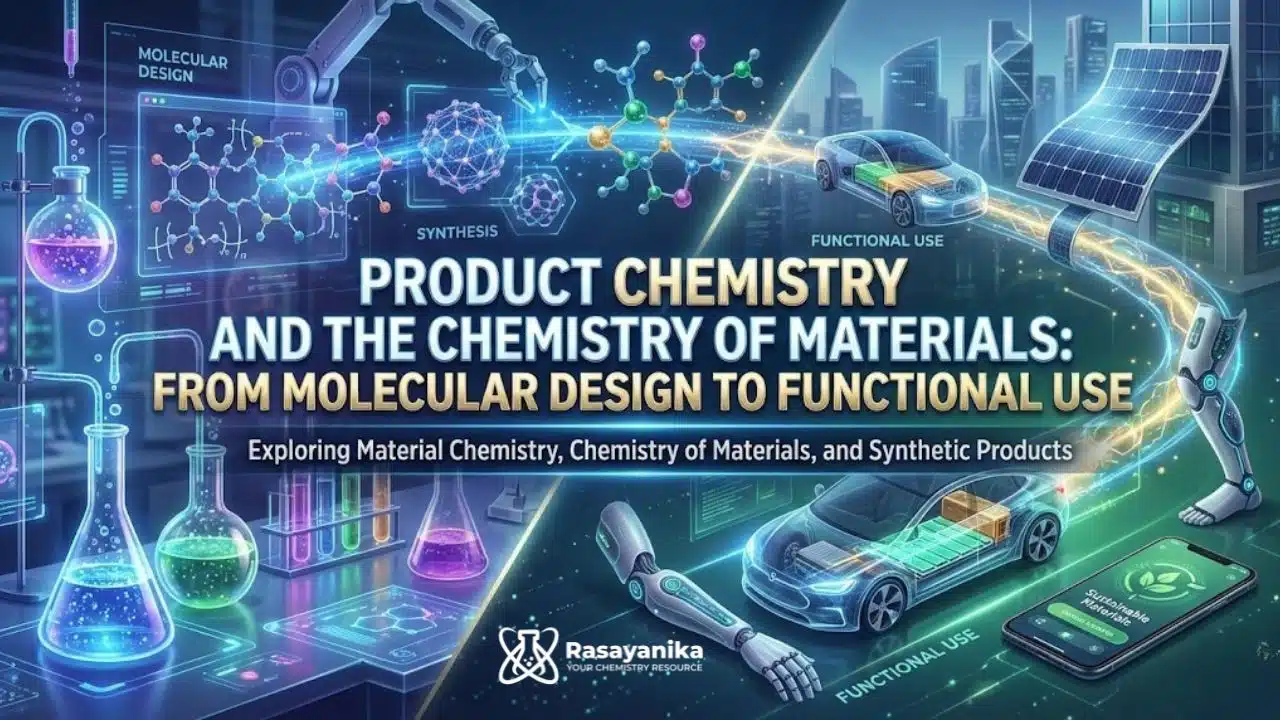
Searching for a field in Chemistry where you can play along with design, how to develop and optimize any chemical materials for any usage in real life or on an industrial scale? Especially, coming to the new generation, i.e, the students, they are more interested in practical knowledge than any textbook-based knowledge, so here to the rescue comes Product Chemistry, which literally acts as the bridge to build the gap that is created between the textbook-based knowledge and the practical industrial ones. Even if you get to know about the potential of a molecule, that’s how it can become anything, starting from medicines, polymers, electronics, or any synthetic products. Now, this field is something that is closely related to material chemistry, which is the branch that deals with structure composition, usability, and performance.
Chemistry of Materials in Detail
This study of materials is especially focused on exploring both atoms and molecules, and how they assemble into various matter like liquids, solids, composites, etc. Materials like ceramics, polymers, nanomaterials, and even hybrids that are mainly focused on the structure-property relationships are due to this particular branch of Chemistry, i.e, Material Chemistry. Then, when it comes to Product Chemistry, the particular products achieved from the chemistry of materials help the researchers work on and improve the stability, flexibility, durability, etc, of the products achieved. Hence, if you do not have a strong hold on the concepts of Material Chemistry, you cannot really design synthetic products that are reliable.
Where it all Starts From: Molecular Designing
Every story starts from the base level; similarly, for products, it starts from the molecular level. Usually, molecules are designed by chemists, which is usually based on their reactivity, compatibility, resistance, etc. A very important role is played by the Chemistry of Materials in the prediction of bulk items and how their molecular structures react. Changing and tuning is in the hands of chemists, wherein just by changing and modifying here and there, like chain lengths, playing along with the functional groups, etc, they can easily meet the required products.
Beginning with lab synthesis, ending with synthetic products
When the first job is done, the molecular designing, what comes next is the synthesis. Mainly, what product Chemistry is all about, making chemistry an economical, sustainable, and scalable field. Reactions that happen in the labs should be done without compromising on the quality, but at the same time, keeping it to be used on an industrial scale. Various methods like sol-gel, polymerization, and solid-state reactions are used in Material chemistry to create up-to-date materials. Hence, industry-ready products are made according to controlled methods; hence, processes are brought from the lab to the industry level.
How Processing and Formulation functions
The step of processing is the step that brings Product Chemistry and engineering together. Wherein, Chemistry of Materials is the branch that works on that area, which deals with the fact of how substances react when molding, coating, casting, etc. Next comes the formulation, which basically works by combining additives with the active compounds to modify and enhance their stability, performance, or appearance. While retaining the properties, throughout the lifecycle, material chemistry ensures the interactions of synthetic products.
Structure–Property–Performance Relationships
The determination of how structures have an impact on how the molecule actually performs is actually the basic core of Product Chemistry. Various tools and equipment are used, like a microscope, spectrophotometer, and other equipment, to check the temperature in the research of Material Chemistry. Let’s say, particle or material size is something that affects the reactivity of materials, whereas if it is the crystallinity of the polymers that affects the strength. When all these properties are kept in place and nurtured, a chemist can now see where to put synthetic products in real life.
Application of Product Chemistry in Industries
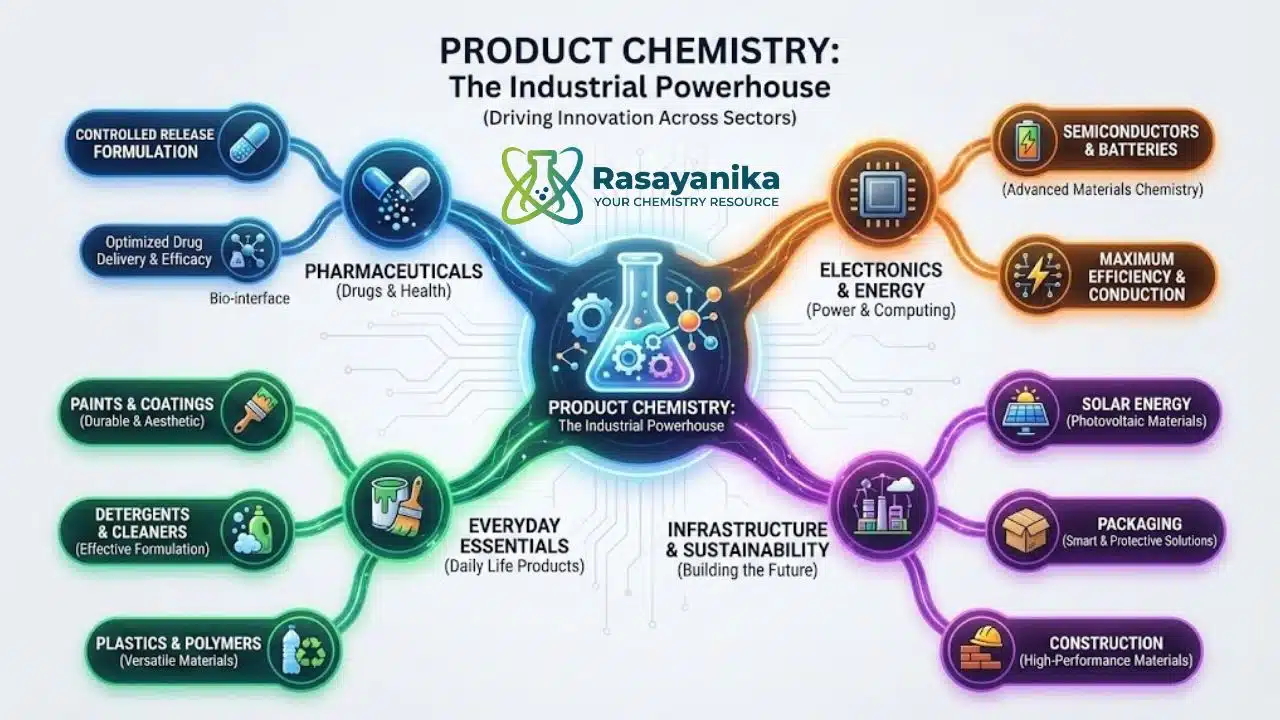
The product chemistry is such a field that leaves an impact on industries overall, like pharma, solar, packaging, construction, etc. For drugs, controlled release is the most important part that is being dealt with by them for their formulation. Similarly, even in electronics, both semiconductors & and batteries are based on the advanced study of the chemistry of materials. It gives the best efficiency and conduction. Talking about all big industries, everything needed in our daily life, from paints, detergents, to plastics, everything is dealt with by this field study.
Sustainability and Green Product Chemistry
Modern Product Chemistry increasingly focuses on sustainability. Green chemistry principles guide the chemistry of materials toward renewable resources, reduced waste, and safer processes. Material Chemistry contributes biodegradable polymers, recyclable composites, and energy-efficient materials. Designing eco-friendly synthetic products is now a key responsibility for chemists, making this field especially relevant for students today.
Studying Product Chemistry: Acquire students with various skills
For building a career in any field, both hard skills and soft skills are equally important; that’s what studying materials or product chemistry does to you, by helping you build skills like analytical, problem-solving, and interdisciplinary skills altogether. Anybody who is searching for opportunities in this field should know that it helps in translating any theoretical knowledge into practical industrial ones. So, they start from knowing about synthesis, characterization, and ultimately, till formulations and scale-up processes for the development of synthetic products. These are the skills that make freshers industry-ready.
Where the future of material and Product Chemistry Takes You
All the upcoming trends regarding Product Chemistry would be highly inclined towards the side of nanotech, digital designing, smart materials, and all. Every day, this particular field of material chemistry is coming up with new innovative materials, such as materials that can self-heal, polymers that give prompt response, and composites that are sustainable. The Material Chemistry major is getting dependent on data so that the chemists can easily and productively design synthetic products. New students who are interested in and choose this field want to build their career in this field, and can shape the future of modern science using trendy technologies.
Thoughts to take away
Chemistry’s tangibility and its impact are discussed by product chemistry that connects molecular design to be used functionally. With material chemistry & chemistry of chemicals being the backbone, it very easily explains how to create, optimise, and apply synthetic products. Especially for newbies, this field gives ideas to make solutions regarding applying any knowledge of chemistry to real-life situations.