


































Table of Contents
AI Learns a Chemist’s Intuition using ChemOntology
Are you curious about how scientists are making chemical research faster and smarter? AI-driven chemical reaction discovery is taking a major leap forward with ChemOntology, a new knowledge-based system developed by researchers at Hokkaido University. By mimicking a chemist’s intuition, this innovative AI helps identify meaningful reaction pathways more efficiently, cutting down computational time and costs while improving the accuracy of chemical analysis.
We can find new drugs, technologies, and materials through chemical reactions, in which we observe the breakage of chemical bonds and the formation of new ones. Usually, this process is time-consuming. It needs both time and money, as chemists have to repeat experiments multiple times, go with trial and error, and even need complex computer calculations to be solved.
A current AI system named ChemOntology was developed by researchers from WPI-ICReDD at Hokkaido University to get a solution for the issue. The team was led by Professor Masaharu Yoshioka and Assistant Professor Pinku Nath, and their work has been published in the journal ACS Catalysis.
What makes ChemOntology special?
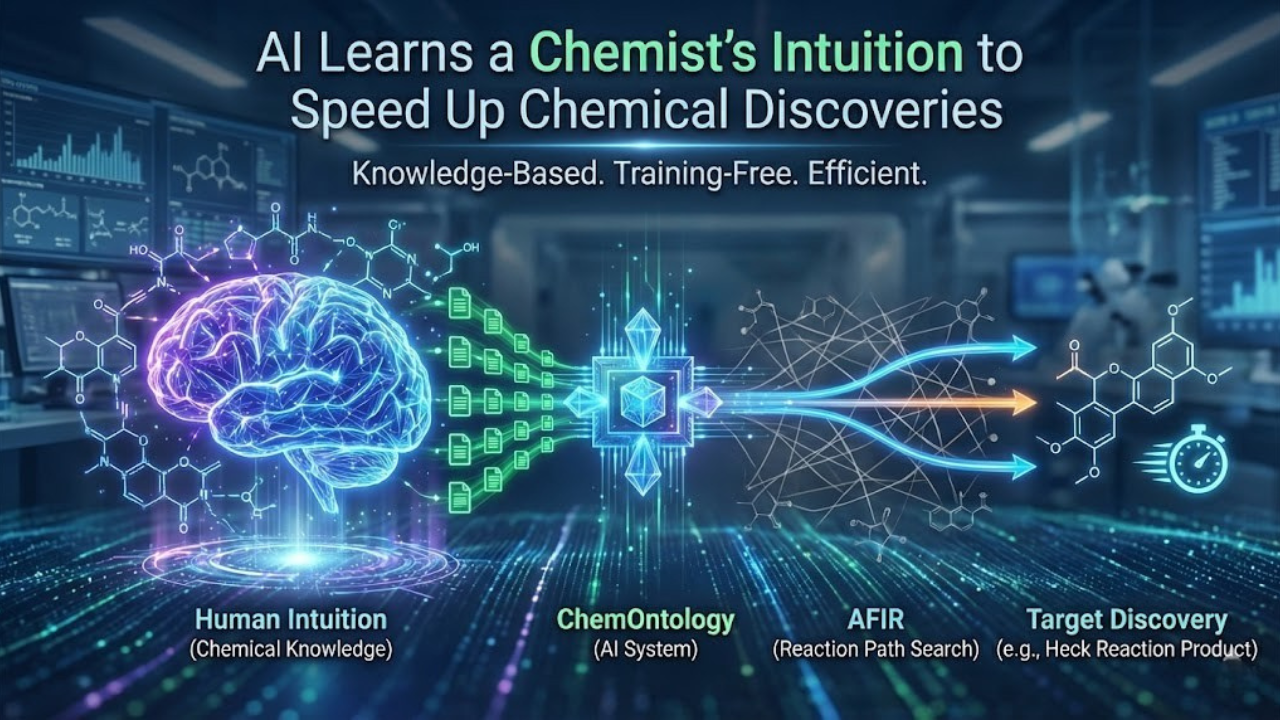
ChemOntology is not like any other AI system; it is designed to work like a human chemist’s intuition. Unlike any other AI system, it makes decisions based on the chemical knowledge it has, saving both time and money.
A Professor named Satoshi Maeda, director of WPI-ICReDD, developed Artificial Force Induced Reaction (AFIR) beforehand, which was brought together with ChemOntology. AFIR works by analyzing various possible molecular reactions, calculating their frequencies, and finding their reaction pathways.
AFIR alone creates too many possibilities on its own, some of which hold no meaning or are not chemically sound. This increases the wastage of time and leads to high computational costs.
Hence, Dr. Yuriko Ono addresses that AFIR selects numerous chemical pathways that a human chemist’s mind would reject immediately, with proper reasoning. Here, ChemOntology steps in.
How ChemOntology helps
All unrealistic molecular structures and reactions are read by ChemOntology, along with the determination of chemical bonds that likely react. In other words, it helps computers to work on human intuition. ChemOntology is not like other AI systems that rely on training datasets. Rather, its unique feature is that it’s purely based on chemical knowledge, hence making it rapid and stable.
Testing the system: The Heck reaction
Heck reaction: a chemical reaction with a complex mechanism was used to analyze and check whether ChemOntology really functions or not. The word complex is seriously proved here, as there are numerous intermediates with three main products and possibly more than ten reaction stages.
When the team used AFIR alone, it could only find some of the reaction pathways. But when AFIR was combined with ChemOntology, the system successfully discovered all the reaction pathways—and did so in half the computational time. Assistant Professor Nath described the result as remarkable.
Why this matters
ChemOntology represents a new type of AI tool for chemistry—one that is knowledge-based, training-free, and guided by human reasoning. It reduces computational costs, saves time, and provides more meaningful results.
The study was a collaborative effort involving computational chemists Dr. Yuriko Ono, Professor Yu Harabuchi, Professor Satoshi Maeda, and Professor Tetsuya Taketsugu, along with experimental chemist Professor Yasunori Yamamoto.
This breakthrough could significantly speed up chemical research and help scientists discover new reactions more efficiently than ever before.