


































Table of Contents
The Ultimate Guide to Chemistry Careers in India: Scope, Salaries, and Skills
Are you thrilled by the chemistry of atoms, molecules, and their reactions, and wondering how to turn that thrill into a way to earn money as well? Chemistry Careers can be the perfect choice, as they give you opportunities to explore across several industries like pharma, healthcare, food, skincare, etc. Chemistry has a lot more potential than you think it has. If you have the right skills and knowledge, you can open doors to high-paying, stable jobs in your field.
This article takes you to the Scope of Chemistry, achievable Chemistry Salaries, in-trend job roles, and the skills you need to train on to achieve your purpose. This guide will be a big saviour for anyone, whether a student, a recent graduate searching for a job, or a professional, helping you with your career decisions.
Why Opt For Chemistry Careers in India?
Chemistry is often considered the central point of science, as it bridges physics, biology, environmental studies, and material science. Chemistry-driven industries are growing at a rapid rate in India because:
- Sudden increase in the Pharma and Biotech industries.
- Increased attention on healthcare and the production of generic medicines.
- Increase in demand for green chemistry.
- Government initiatives like Make in India and PLI schemes
This makes Chemistry Careers not only versatile but also future-proof. This makes Chemistry Careers not only stable but also future-proof.
Have you ever asked yourself what you enjoy the most? Lab work, data analysis, quality checks, or research-based problem solving. Figure this out, and Chemistry gives you a career guide for each of your interests.
Scope of Chemistry in India: Career Opportunities for Chemists
In India, the scope of chemistry is not necessarily dependent on working in labs nowadays. Now, chemists have job opportunities in various companies, and each offers different expanded career options and growth opportunities. Starting from research and medicines to manufacturing and environmental work, people who are skilled have a wide range of options for a well-paying job.
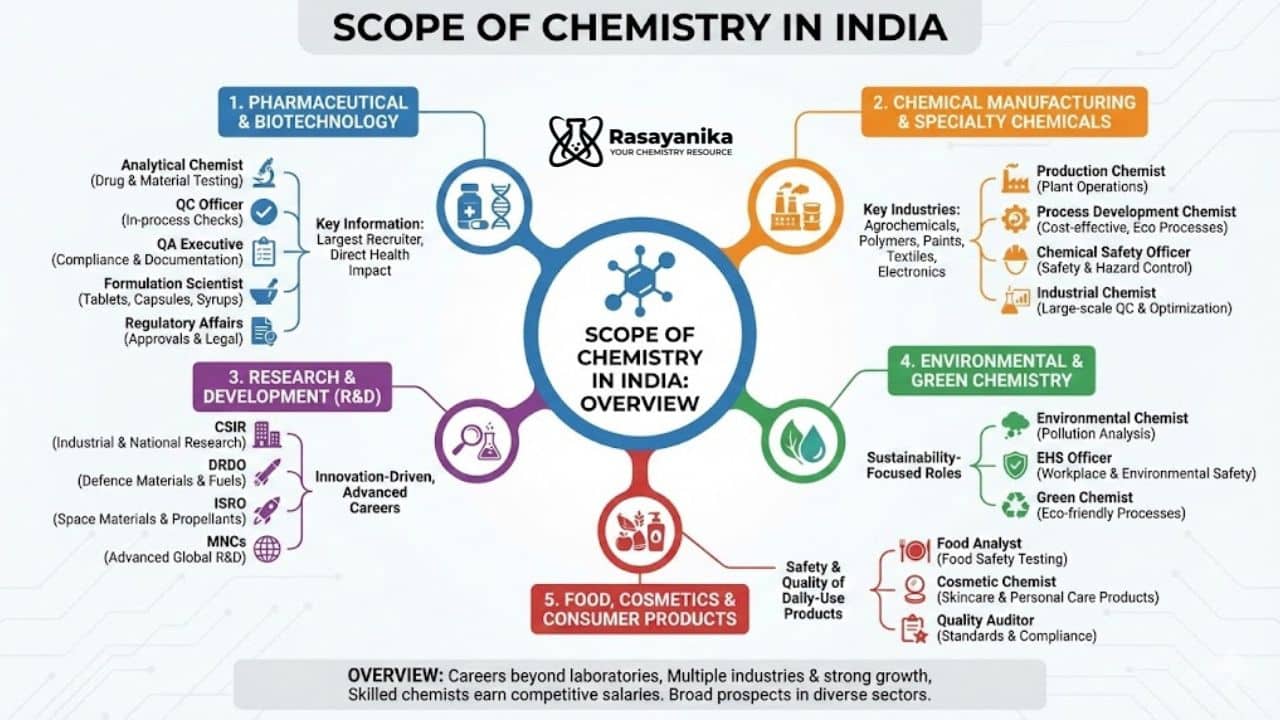
1. Pharmaceutical and Biotechnology Industry
Chemistry passouts in India get a huge ratio of jobs from the pharma and biotech industries. It provides secure careers, opportunities to grow, and plays an important role in impacting human health.
- Analytical Chemist
Analytical chemists check and analyze raw materials, finished medicines, and test samples to ensure they are up to the mark or not. Their role plays a huge role in ensuring the drug safety, effectiveness, and consistency. - Quality Control (QC) Officer
They test the medicines at different steps of production. These routine checks are done to verify whether the products actually meet the approved requirements before they reach the public. - Quality Assurance (QA) Executive
These executives work on the overall quality systems. Their work is to monitor whether the manufacturing processes are done properly by following the regulations and with proper documentation at each step. - Formulation Scientist
These scientists work on developing and improving drug products like capsules, tablets, or syrups. Their job is to make medicines more effective, stable, and easy to use. - Regulatory Affairs Professional
Essential Approvals and documentations required by the health board are handled by these Professionals. They act as a bridge between the company and regulatory bodies to make sure that products meet all the legal and safety needs.
2. Chemical Manufacturing and Specialty Chemicals
India works as one of the main hubs of chemicals used in industries like agriculture, electronics, paints, polymers, and textiles. Steady and stable growth in a career can be achieved by professionals from this field.
Production Chemist
A production chemist’s job is to look over every day’s manufacturing functions in chemical plants. Their work is to make sure that the products that are delivered are made with full efficiency, while meeting all the quality standards and safety regulations.
Process Development Chemist
These chemists try to improve the methods involved in manufacturing. They want to achieve chemical procedures that are stable, economically sound, and eco-friendly.
Chemical Safety Officer
Workplace safety and regulatory compliance are important as well; those who focus on these are called the Chemical Safety Officers. They detect potential hazards, ensure their proper handling, storage, and disposal.
Industrial Chemist
Chemists who work on a large scale or on an industrial scale use their chemical skills. They work on solving problems that are related to QC, effectiveness, and optimized processes.
This field gives you a stable, long-term career, especially for people who have hands-on experience in industries or green environments.
3. Research & Development (R&D)
R&D is for people who enjoy creating new things, innovations in chemistry careers. This industry is based on discovery, checks, and improvement of products, materials, and processes.
CSIR Laboratories
CSIR labs provide research jobs in fields like material science, environmental science, and pharma. Scientists in these labs work on short-term projects that mainly support industrial needs and help in developing the nation.
DRDO
The DRDO employs chemists who work on defence-related research. Their Job is to create certain advanced items, fuels, or other protective materials for national security.
ISRO
ISRO works on research related to space missions. This exploration involves analyzing and researching materials such as propellants, coatings, and other life-support materials used in space.
Global MNCs
Some MNCs offer exposure to advanced research technologies and global projects. People working in this field work on the intersection of newly innovated technologies and international collaborations.
4. Environmental, Green, and Sustainable Chemistry
Nowadays, environmental safety standards have become stricter, and scientists play a significant role in conserving nature and promoting sustainable practices. This field promotes earning money without harming the environment, rather than saving it from hazards and making it safer for people.
Environmental Chemist
These chemists study environmental substances like air, water, and soil to analyze pollution. Hence, after analysis, they identify ways to reduce or eliminate certain chemicals that harm the environment, which benefits both the company and the government.
EHS (Environment, Health & Safety) Officer
Workplace hazards are increasing nowadays, and EHS officers are those who supervise workplace safety. They ensure there are fewer hazards and make sure the employee and the surrounding area remain safe.
Green Chemistry Researchers
Scientists who create environmentally friendly chemical procedures and products are called Green Chemistry Researchers. They want to achieve products with minimal waste during production and the elimination of hazardous chemicals.
This field is growing quickly and offers strong career opportunities for chemists who want to work toward a cleaner and more sustainable future.
5. Food, Cosmetics, and Consumer Products
They work to make the products we use every day safe, effective, and of optimal quality. Their work involves analyzing and manufacturing food items, cosmetics, and everyday products.
Food Analyst
Their work is to ensure that each ingredient going into a food meets specific legal standards and is safe for consumers.
Cosmetic Chemist
Their job is to analyze and create products that do not harm skin and cause allergies. They develop products such as face creams, shampoos, and other daily skincare products and focus on making them stable, safer, and more pleasant to use.
Quality Auditor
Their work is to supervise and review standard protocols for both processes and products. They help keep the standard quality of a brand and consistent quality with industrial regulations.
Chemistry Salaries in India: What Can You Expect?
- Entry-Level (0–2 years): 2.5 – 4.5 LPA
Freshers generally start with normal labs or QC roles. Specific jobs, like QC analysts, Trainee Chemists, etc., focus on building your base and hands-on experience through routine checks and documentation. This stage acts as a building block of your career.
- Mid-Level (3–7 years): 6 – 10 LPA
After working in the industry for a few years and gaining experience, professionals can take on more responsibilities. Suitable roles like Senior Analyst, Executive QA, or R&D professionals are considered, as they can improvise, troubleshoot, and mentor juniors. Growth in salary depends on experience.
- Senior-Level (8+ years): 12 – 25+ LPA
Chemists in this stage are mainly into supervising, leadership, and decision-making roles. Pay scale is much larger as it comes with a lot of experience and accountability. Roles like Manager, regulatory head, etc., are considered for this level.
High-Paying Chemistry Careers
- Regulatory Affairs
- Intellectual Property (Patent Analyst)
- Data-Driven Chemistry Roles
- International R&D Positions
Essential Chemistry Skills Employers Look For
Academic knowledge alone is no longer enough. Employers seek a blend of technical and professional Chemistry Skills.
Technical Skills
- Analytical Techniques (HPLC, GC, UV, FTIR)
These tools are used to test and identify chemicals and compounds in the lab. Knowing how to handle these instruments helps ensure results are accurate and reliable. - Method Development and Validation
This skill involves creating new testing methods and checking that they work correctly every time. It ensures tests are consistent, trustworthy, and meet industry standards. - Chemical Synthesis and Scale-Up
This focuses on making chemical compounds in the lab and then producing them in larger quantities. It requires careful planning to maintain quality and safety during production. - Documentation and SOP Writing
Proper documentation helps keep lab work organized and traceable. Writing clear SOPs ensures everyone follows the same steps and maintains consistent quality. - GMP, GLP, ISO Compliance
These standards make sure laboratory and manufacturing work is safe and well-controlled. Understanding them helps companies meet legal requirements and maintain high-quality practices.
Digital & Emerging Skills
- Data Analysis and Basic Programming
These skills help chemists organize, analyze, and interpret large sets of experimental data. Basic knowledge of tools like Excel, Python, or R can make daily lab work faster and more accurate. - Chemometrics
Chemometrics uses mathematical and statistical methods to better understand chemical data. It helps in identifying patterns, improving experiments, and making smarter decisions from results. - Laboratory Information Management Systems (LIMS)
LIMS is used to store, track, and manage lab data digitally. Knowing how to use these systems improves efficiency, reduces errors, and keeps records well organized. - AI and Computational Chemistry (for Advanced Roles)
These tools are used to predict reactions, design molecules, and accelerate research. While more advanced, they offer strong career growth for chemists working in modern R&D environments.
Soft Skills
- Problem-solving
The ability to identify issues and find practical solutions is essential in chemistry roles. It helps professionals handle challenges in experiments, production, and quality checks. - Attention to detail
Minor errors can lead to big problems in chemistry. Being careful and precise ensures accurate results and safe outcomes. - Communication and reporting
Chemists need to explain their findings through reports and presentations clearly. Good communication helps teams and management make informed decisions. - Team collaboration
Most chemistry work involves working with others. Being able to cooperate and share ideas leads to better results and smoother workflows.
Final Thoughts
The scope of chemistry in India is broad, evolving, and full of opportunities. With attractive salaries and many career options, chemistry remains a stable and flexible career choice in the science field. By building the right skills and matching your interests with what industries need, you can shape a rewarding and long-term career.
Whether your goal is pharmaceuticals, research, sustainability, education, or any other sector, chemistry offers paths for all kinds of interests—provided you plan your journey thoughtfully.