































Table of Contents
Chemical Oceanography: An Introductory Overview of Ocean Chemistry
Do you know that oceans cover more than 70% of the Earth’s surface? They help in regulating the climate, support life, and maintain biogeochemical cycles. The ocean might look calm & an endless blue blanket, but beneath its blue surface lies a chemical engine that works continuously without any rest. These waves are essential for regulating the Earth’s climate and sustaining marine life. Each wave carries dissolved salts, gases, and nutrients essential to support life on Earth.
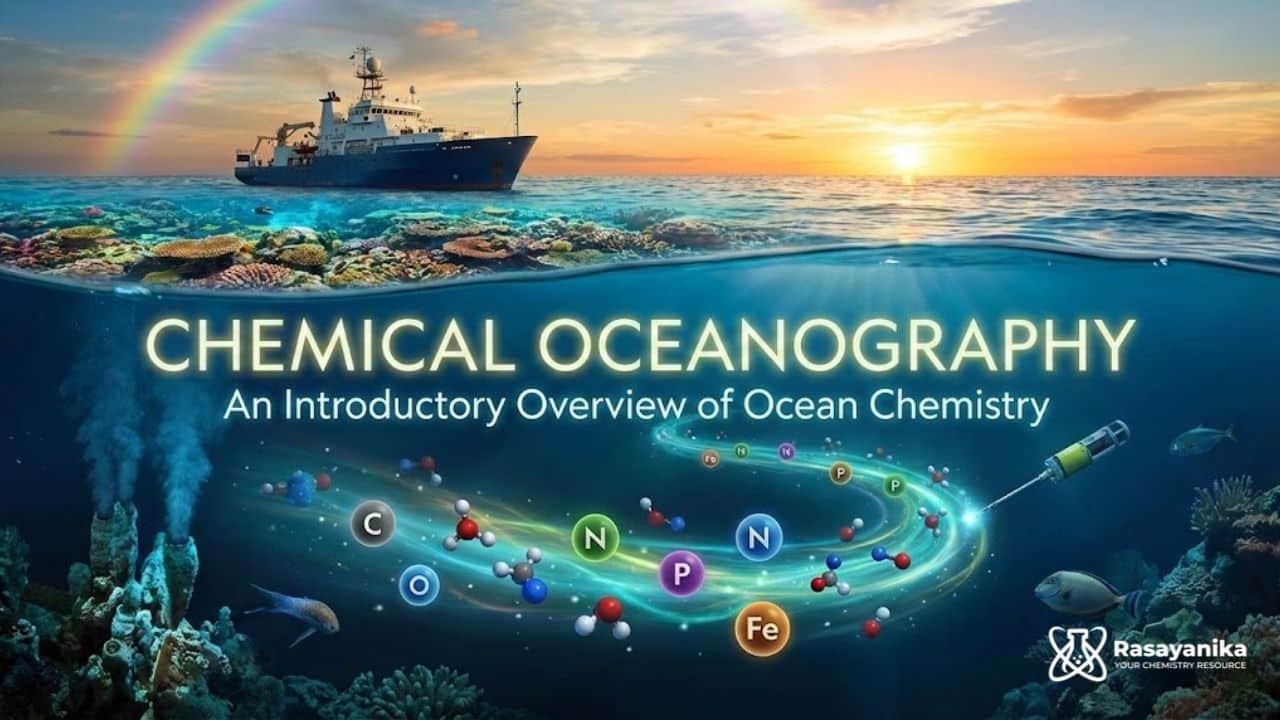
Chemical Oceanography is a branch of ocean science that studies and understands the chemical compositions of seawater and different processes, such as its interaction with the atmosphere, seafloor, and living organisms.
The connection between the ocean and the climate systems is discussed in our cluster article “Ocean Chemistry and Climate Change: A Critical Link.” For a detailed version of this, explore how ocean chemistry influences the global climate systems.
Chemical Oceanography also overlaps with marine chemistry and atmospheric chemistry because they concentrate on chemical reactions in the marine environment and explore the exchange of particles and gases between the ocean and the atmosphere, respectively.
In this article, we will have a detailed overview of chemical oceanography, ocean chemistry, and how it is related to marine chemistry, atmospheric chemistry, and some other border concepts.
What is Chemical Oceanography?
This is the study of chemistry that focuses on the chemical constituents and properties of seawater, and their chemical reactions within the sea. It explains how chemicals in the marine atmosphere are distributed, transformed, and recycled. This forms a strong foundation of ocean Chemistry and Marine Chemistry.
This field test for various types of chemical components,like major elements, essential nutrients, which are the dissolved gases, and organic matter, and also explores their interactions. Such interactions are responsible for the composition of the seawater, its biological productivity, and the overall functioning of the aquatic ecosystems.
What are the primary components in seawater?
- Concentration of salts: the distribution of major ions that determines the salinity of seawater and controls core ocean chemistry processes.
- Trace metals: elements like iron, copper, and zinc that influence the productivity of marine organisms and also the chemical speciation in the seawater.
- Organic compounds: organic matter in dissolved and particulate form. It drives both biological and chemical reactions in marine chemistry.
- Atmospheric Chemistry: the interactions of gases such as carbon dioxide and oxygen.
- Buffering and acidification: It involves the ocean’s carbonate system and its role in regulating the pH.
- Nutrient Cycling: Chemicals such as phosphorus and nitrogen are transformed into nutrients like nitrogen and phosphorus through marine systems.
Analytical Chemistry allows precise analysis and measurement of the elements, nutrient gases, and organic compounds in the ocean and provides precise data for chemical oceanography and ocean chemistry research and studies.
Role of Marine Chemistry
Marine Chemistry is a branch of chemical oceanography that studies the chemical processes occurring within the ocean and the living organisms. It emphasizes how chemical elements, compounds, and their reaction quietly shapes the marine atmosphere. By studying these processes, scientists can predict changes in the chemistry of the ocean and how it is affected by humans.
Major Components:
- Nutrient dynamics and primary productivity: It is the investigation in which the availability and movement of essential nutrients such as nitrogen, phosphorus, and silicate and etc, are checked. These nutrients are essential because they drive the growth of phytoplankton and sustain the food web of marine organisms.
- Cycling of carbon, nitrogen, and phosphorus: Study of these elements to understand how they are transformed and transported through biochemical processes. These processes are linked with ocean chemistry, climate regulation, and the balance of the ecological system.
- Chemical speciation of metals: It is the examination of the influence of trace metals like iron, copper, and zinc in their chemical forms. They directly affect the bioavailability, toxicity, and overall marine life and the ecosystem.
What is Chemical Speciation?
It is the identification and distribution of various types of chemical elements or compounds present in a solution, like seawater. These elements can behave differently, eg, Fe(iron) can float freely in the ocean and can stick to particles or bind with organic matter, while Carbon exists in the form of CO2, bicarbonate, or carbonate and influences the acidity of the seawater.
Processes in Ocean Chemistry
Chemical Oceanography studies how the dynamic processes, such as nutrient cycles and chemical speciations, govern the composition and behaviour of the seawater. If we understand these essential processes, then we can predict the changes in ocean chemistry. The following are the processes in ocean chemistry:
- Salinity and Ionic Composition: It is the distribution of major ions that affects seawater density, its circulation patterns, and the solubility of gases.
- Gas Exchange & Atmospheric Interaction: Exchange of gases between the ocean and atmosphere, such as CO2 and O2, influences the climate and the marine ecosystem. This makes a connection between the chemical oceanography and atmospheric chemistry.
- Nutrient Cycling: Nutrients that are vital to support life, such as nitrogen, phosphorus, and silica, are transformed into nutrients and transported in the ocean and driving the growth of phytoplankton and overall marine ecosystems.
- Chemical Speciation & Trace Elements: These are present in many forms and are responsible for bioavailability and ecological effects on marine organisms.
- Ocean Acidification: When there is an increased absorption of CO2 in the water, the pH of the water decreases, and it alters the carbonate systems. These changes are studied through analytical chemistry to get a better understanding of the ocean’s response to climate change.
Tools & Techniques
Modern chemical oceanography highly depends on advanced tools and techniques to give precise results. They use these tools and techniques to analyse and study the composition of seawater and to monitor changes in ocean chemistry. The following are the few tools and techniques that are used by scientists to measure elements, compounds, or compositions of substances and physical parameters with high precision:
- Spectroscopy: It is used for analyzing trace elements in the seawater. It helps the scientist to understand the trace element concentrations.
- Chromatography: It is used to separate and identify chemical compounds, present in both organic and inorganic substances ,to study their interaction and behaviour.
- Mass spectrometry: It helps in determining isotopic components of an element, which include information about its source, cycle, and transformation processes in the ocean.
- In-situ sensors: These sensors measure parameters like temperature, pH, and dissolved gases in the marine ecosystem and enable researchers to continuously monitor chemical changes.
These advanced tools together allow researchers or scientists to study the ocean chemistry pattern in a detailed form, along with the environmental changes and chemical speciation to support research in climate effects, nutrient cycle dynamics, and the health of the ecosystem.
Applications
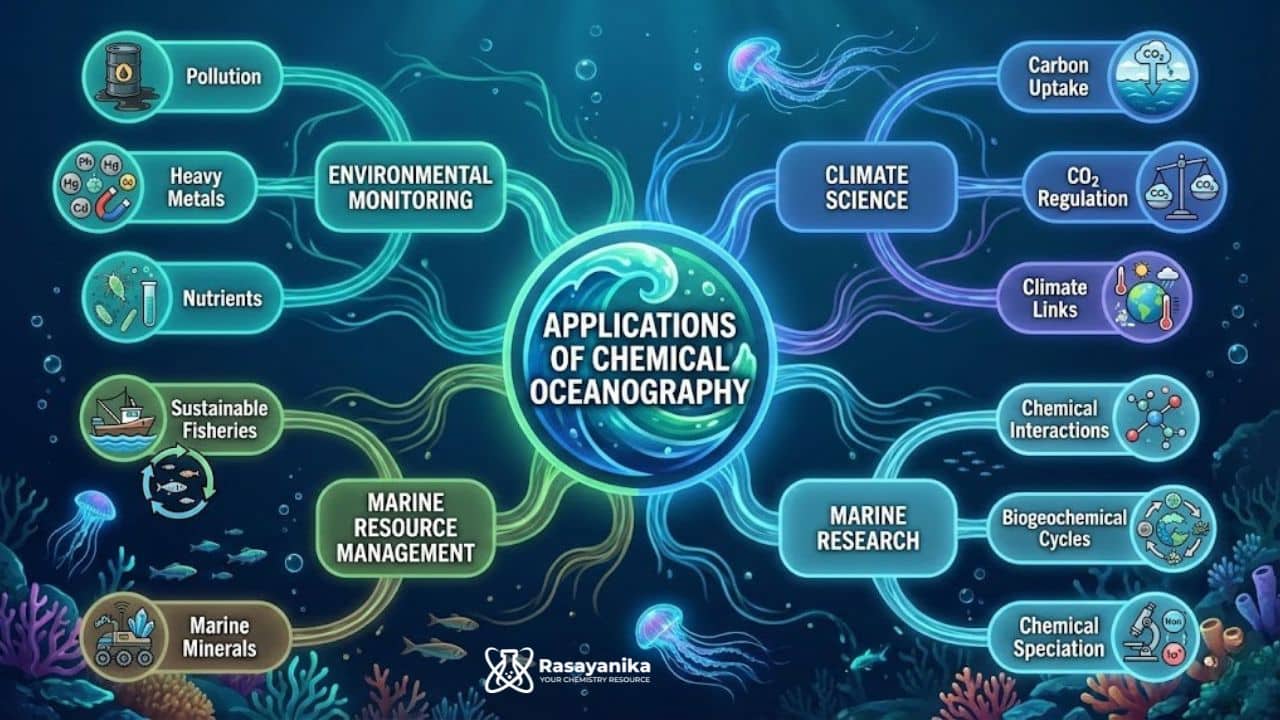
Chemical Oceanography has many applications that help us to understand and manage the oceans. These applications can track pollution, changes in the nutrient level, and the uptake of carbon atoms. The following are the applications:
- Environmental Monitoring: These help in tracking pollutants, heavy metals, and nutrients. Monitoring these factors will provide insights into how humans are affecting ocean chemistry and the marine ecosystems.
- Climate Science: They study the ocean carbon uptake and its role in the regulation of atmospheric carbon dioxide.
- Marine Resource Management: It will help in supporting the sustainable use of resources like minerals and fisheries, and many other ocean assets by understanding the chemical conditions that affect the productivity and the marine biodiversity.
- Marine Research: The chemical interactions, biochemical cycles and chemical speciation will help in marine research and in advancing knowledge of the marine processes and the dynamics
These applications of chemical oceanography are essential and help in protecting the environment, climate studies, and managing the resources of the ocean to ensure sustainability.
The integration of marine chemistry, atmospheric chemistry, and analytical chemistry, chemical oceanography provides a thorough understanding of the chemical processes that shape and form the ocean. Scientists can monitor marine ecosystems, manage ocean resources sustainably, and forecast climate changes more accurately with a deeper understanding of ocean chemistry.
In order to solve global issues such as pollution, deteriorating ocean health, and climate change, this field is essential. Chemical oceanography is essential for scientists, environmentalists, and governments who are trying to safeguard the world’s seas because it provides significant opportunities for scientific discovery, creativity, and workable solutions driven by continuous advancements in research methodologies and technology.











Hai I want in this field intership where I have to apply in this link. I can’t find any additional