































A Simple Chemistry Discovery Could Give Plastics an Expiration Date
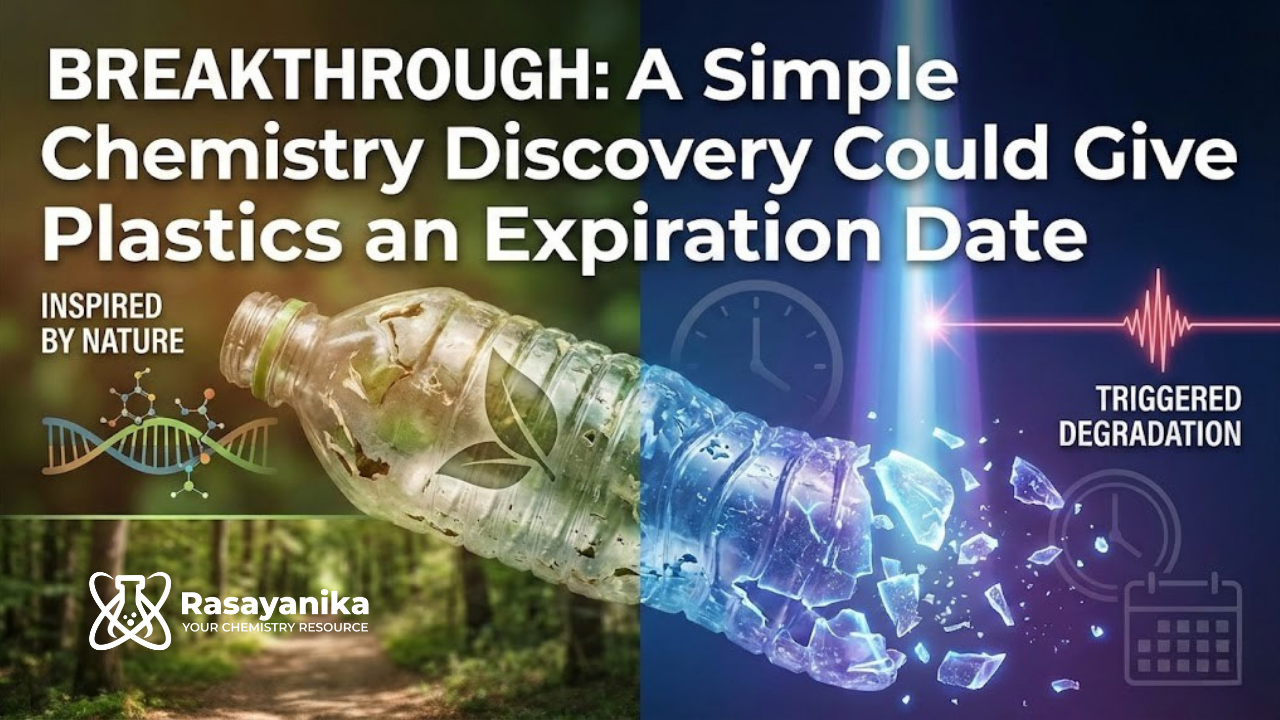
While walking in nature, a Rutgers Chemist had a thought regarding waste caused by plastics. Passing by the trails, it crossed his mind why it is that man-made or artificial plastics, made by humans, do not degrade and last forever, while the natural substances like DNA and proteins break down easily with time? This curious thought made researchers brainstorm and come up with a new idea that one day could create plastics with built-in expiration dates.
Nature only came as a savior for the scientists by giving them the idea to create plastics that are easily degradable. DNA and proteins are not fragile, and they keep up under normal conditions, but can break down under certain controlled conditions. Hence, picking up certain structural features from nature and incorporating them into plastics, scientists created certain plastics that are just as strong and stable as those in the market, but once exposed to certain reactions, they can trigger the breakdown. This process can be done in days, or might take years , or something in between. These reactions can be triggered by using certain chemical signals that are easy to kick-start. This can be a revolutionary discovery for plastics used in daily life, like food, personalized medicines,etc.
At the same time, scientists are learning more about how liquids behave at the smallest scales. Liquids may look calm, but at the molecular level, they are always moving. When sugar dissolves in water, each sugar molecule is quickly surrounded by constantly shifting water molecules. Inside living cells, tiny liquid droplets move proteins and RNA and help control chemical reactions.
Studying liquids has always been difficult because they have no fixed structure. The most important chemical interactions happen extremely fast, in tiny fractions of a second, making them hard to observe.
Researchers from Ohio State University and Louisiana State University have now found a way to see these fast events using a technique called high-harmonic spectroscopy (HHS). This method uses very short laser pulses to pull electrons away from molecules. When the electrons snap back, they give off light that reveals how electrons and atoms move. These events happen in attoseconds, which are a billionth of a billionth of a second.
Until now, HHS mainly worked with gases and solids. Liquids were harder because they absorb light and their molecules are always moving. To solve this, the team created an ultrathin sheet of liquid that lets more light escape. This allowed them to study liquids for the first time using HHS.
They tested mixtures of methanol with halobenzenes, molecules that differ by only one atom: fluorine, chlorine, bromine, or iodine. Most mixtures behaved as expected. But fluorobenzene mixed with methanol gave a surprising result. It produced less light than either liquid alone, and one specific light signal disappeared completely.
Computer simulations showed why. Fluorobenzene forms a special hydrogen bond with methanol, creating an organized structure. This arrangement blocks electron movement, disrupting the light signal. The missing signal revealed details about the local liquid structure.
This discovery matters because many critical chemical and biological processes happen in liquids. Understanding how electrons move in these environments could help advance chemistry, biology, and materials science. The study was supported by the U.S. Department of Energy and the National Science Foundation.