
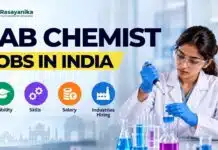




















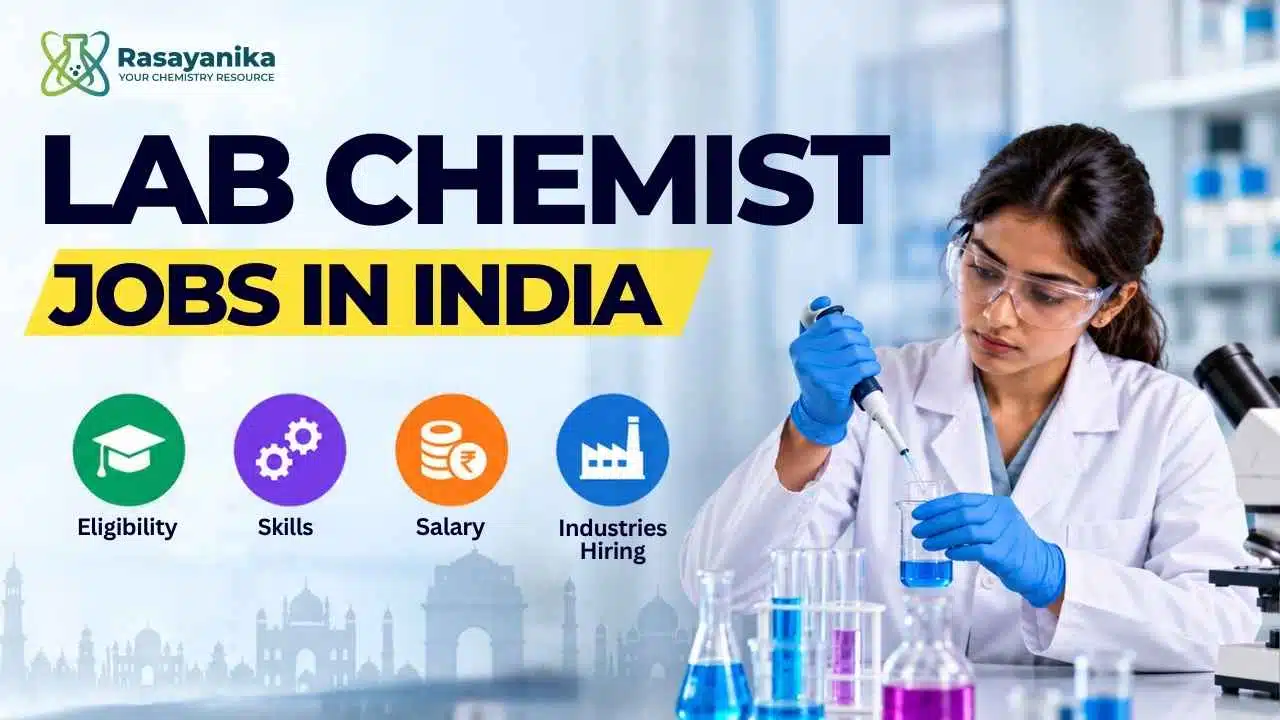
Many of us think that a lab chemist’s work is only to spend all day mixing chemicals and running tests, but there is much more to the job than that. Lab chemists play a very important role in testing medicines, drinking water, and checking foods, paints, fertilizers, or even everyday products. They make sure that all the things that we are using are safe, effective, and up to the standard set. Lab Chemist Jobs for freshers combine hands-on testing with quality, safety, and documentation responsibilities across industries.
And you know what the best part is? You don’t even need to have years of experience to start as a lab chemist. Even as a science graduate or fresher, a laboratory chemist role can open many doors in different fields such as pharma, chemicals, food, environmental testing, manufacturing, and a lot more.
When it comes to what the lab chemist actually does, what qualifications and what skills does it require? Even how much can you earn, and where can you find these jobs? This article contains everything from start to finish. So let’s not waste any time. And break it all down.
What Are Lab Chemist Jobs?
So what exactly does a lab chemist do? The main work of the lab chemist is to perform chemical analysis and to test and get the actual composition or determine the composition, quality, properties, whether materials and products meet the required standards.
The Government of India’s Directorate General of Employment (DGE), through the National Classification of Occupation (NCO), also organizes a lot of several related occupations. These include roles such as
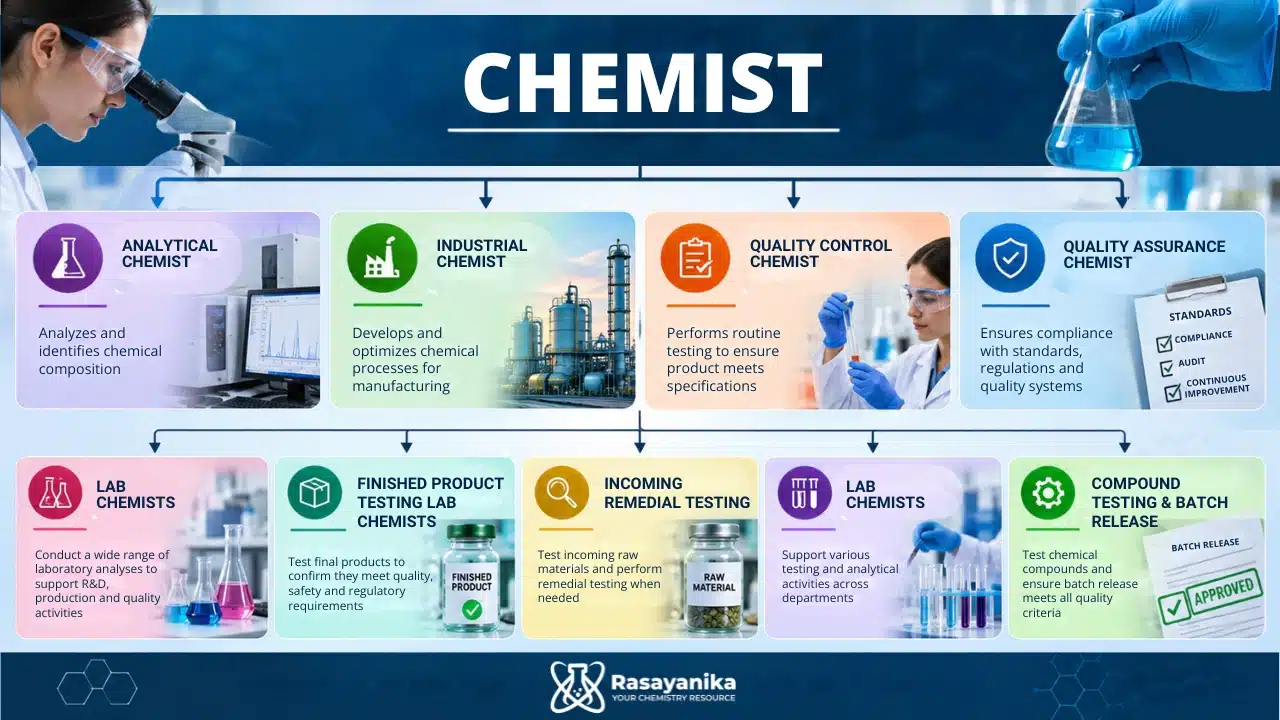
These are a few relevant roles that come under the lab chemist job role.
Lab Chemist Qualifications and Eligibility
For lab chemists, the eligibility depends on the sector in which we are working as well as the seniority of the role. Most of the employers from public sector units or private companies follow a similar academic structure that is given in the table below.
| Level | Typical Qualification | Common Entry Roles |
| Entry-level | B.Sc. in Chemistry (or Industrial/Applied Chemistry) | Lab Assistant, Junior QC Chemist, Trainee Chemist |
| Mid-level | M.Sc. in Chemistry (Analytical, Organic, Inorganic, or Physical Specialization) | QC/QA Chemist, Analytical Chemist, Production Chemist |
| Specialized/Senior | M.Sc. with industry experience, or Ph.D. in Chemistry | Senior Chemist, R&D Scientist, Regulatory Affairs Chemist |
| Vocational/Diploma | Diploma in Chemical Engineering or Chemical Laboratory Technology (NSDC-aligned) | Lab Technician, Quality Control Assistant |
Government and public-sector recruiters such as ONGC have run apprenticeship drives for lab chemist and analyst roles that require a B.Sc. in Chemistry from a recognized university. Broader government notifications typically ask for a bachelor’s or master’s degree in Chemistry, Analytical Chemistry, Industrial Chemistry, or a related discipline from a recognized institution. Private employers in pharmaceuticals and specialty chemicals often prefer M.Sc. holders for analytical or formulation roles, while a B.Sc. is generally sufficient for entry-level testing and QC positions. For those exploring laboratory jobs after chemistry, this tiered structure means you can start working right after graduation and move up as you add a postgraduate degree, certifications, or hands-on instrument experience.
Many government and public sector recruiters, such as ONGC, run a lot of apprenticeship trials for lab chemist roles or analytics roles, which generally require an obvious BSc in chemistry from a recognized university.
In other government notifications, you will find that they usually ask for a Bachelor of Masters degree in chemistry, analytical chemistry, industrial chemistry, or a relevant discipline from a recognized institution.
Coming to private companies such as pharmaceutical or specialty chemical industries, they require an MSc holder for analytical and formulation roles, whereas a BSc is still generally required for many entry-level testing or QC positions.
For people who are exploring laboratory jobs after a chemistry degree, this structure means that you can start working right away after graduation and move up step by step as you do a postgraduate degree, hold certification, or gain hands-on industrial experience.
Skills Required for Lab Chemist Freshers Jobs:
The technical knowledge and the workplace responses matter equally in this field.
Technical Skills:
- Hands-on training on instruments such as HPLC, GC, UV-visible spectrophotometers, and titrators.
- A better understanding of analytical and organic chemistry fundamentals helps a lot.
- Familiarity with GLP/GMP documentation and standard operating procedures.
- The ability to interpret basic statistical results, calibration checks, and data recordings.
- Working knowledge of lab software and LIMS (i.e., laboratory information management systems).
Workplace and soft skills:
- Precision and attention to detail, since even small errors can affect product safety
- Ability to work in rotational shifts, common in QC labs and manufacturing plants
- Clear technical reporting and coordination with production, QA, and R&D teams
- Adherence to laboratory safety protocols when handling reagents and hazardous substances
Employers in pharmaceuticals, cosmetics, food, petrochemicals, specialty chemicals, and FMCG manufacturing increasingly expect candidates to combine academic qualifications with practical awareness of laboratory operations, quality systems, analytical instruments, and regulatory compliance. This is precisely why lab chemist jobs for freshers often include a structured training or probation period before full responsibilities are handed over.
Lab Chemist Salary in India (From Fresher to Experienced):
Pay for lab chemists varies considerably by qualification, industry, city, and years of experience. There is no single “official” figure; different salary platforms report different ranges depending on their sample size, so the table below presents a consolidated, realistic band drawn from multiple sources.
| Career Stage | Approx. Annual Salary (CTC) | Notes |
| Fresher (B.Sc. Chemistry) | ₹1.8 – 3.5 LPA | Entry-level QC/lab assistant roles |
| Fresher (M.Sc. Chemistry) | ₹3 – 6 LPA | Analytical/R&D trainee roles |
| Mid-level (3–5 yrs experience) | ₹3.5 – 6 LPA | QC chemist, production chemist |
| Senior chemist/team lead | ₹5.5 – 12 LPA | Pharma, biotech, specialty chemicals |
| Experienced R&D/specialist roles | ₹8 – 18 LPA | Analytical development, regulatory affairs |
Entry-level chemists typically earn between ₹1.8 and ₹3 LPA; professionals with three to five years of experience can expect ₹3 to ₹5.5 LPA, and senior QC chemists or team leads may earn between ₹5.5 and ₹12 LPA, particularly in pharmaceutical or chemical companies. Master’s-level chemistry graduates commonly start in the ₹3–6 LPA range, while those in analytical chemistry or managerial quality roles at larger pharma and chemical companies can cross ₹12–18 LPA with experience.
A few factors consistently push salaries higher:
- Specialization: in analytical instrumentation, formulation, or process chemistry
- Industry: API manufacturing units, biotech firms, and multinational companies generally offer higher compensation and shift allowances than smaller testing labs.
- Location: metros such as Mumbai, Pune, Hyderabad, and Bengaluru tend to pay more than smaller industrial towns
- Regulatory exposure: experience with USFDA/EU audits or export-oriented units commands a premium
Government lab chemist posts follow official pay-level structures (as per the 7th Central/State Pay Commission), which offer lower starting figures than top private-sector pay but come with allowances, job security, and pension benefits.
Top Industries Hiring Lab Chemists:
Lab chemists and laboratory analysis opportunities extend well beyond pharmaceutical companies.
| Industry | Examples of Laboratory Roles |
| Pharmaceuticals & API Manufacturing | QC Chemist, Analytical Chemist, Raw Material Analyst, Stability Testing |
| Biotechnology & Contract Research | Analytical Chemist, Research Associate, Laboratory Analyst |
| Specialty Chemicals & Petrochemicals | QC Chemist, Product Testing Chemist, Laboratory Analyst |
| Food & FMCG | Quality Chemist, Laboratory Analyst, Food Testing roles |
| Cosmetics & Personal Care | QC Chemist, Formulation Support, Stability Testing |
| Paints, Coatings, Fertilizers & Agrochemicals | QC Chemist, Raw Material Testing, Product Testing |
| Environmental & Water Testing | Environmental Chemist, Water Analyst, Laboratory Analyst |
| Contract Testing & Certification Laboratories | Analytical Chemist, Testing Chemist, Laboratory Analyst |
| Government & Forensic Laboratories | Chemist, Scientific Assistant, Analyst, or other notification-specific scientific roles |
Important: Titles such as Food Safety Analyst, Forensic Analyst, and certain environmental-testing positions may carry specific statutory, educational, or experience requirements. Being a chemistry graduate alone does not automatically make a candidate eligible. Always verify the individual vacancy notification.
The work also differs across industries. Pharmaceutical laboratories may place greater emphasis on regulated documentation, chromatographic testing, and approved analytical methods. A chemical-manufacturing laboratory may focus on raw materials, process samples, and product specifications. Process engineering itself is a separate function and should not be treated as synonymous with laboratory chemistry.
Hiring organizations may include manufacturing companies, pharmaceutical and chemical plants, contract research organizations, independent testing laboratories, certification laboratories, environmental laboratories, and government research or testing facilities.
Career Progression for a Lab Chemist
There is no fixed career ladder that every laboratory chemist follows. However, an example progression may look like this:
- 0–2 years: Trainee / Junior Chemist: Sample preparation, routine testing, documentation, and instrument operation under supervision
- 2–5 years: Chemist / Analyst: Greater responsibility for independent analysis, troubleshooting, documentation, and investigation support
- 5–8 years: Senior Chemist / Senior Analyst / Team Lead: Advanced testing, technical troubleshooting, mentoring, and, where relevant, method transfer or development
- 8+ years: Specialist or Managerial Paths: Laboratory management, analytical development, technical specialization, quality systems, R&D, or other leadership functions depending on experience and qualifications
These years are illustrative rather than mandatory milestones. Promotions depend on performance, available roles, technical competence, industry, and organizational structure.
A move from QC into QA, regulatory affairs, R&D, or management is also not automatic. Each pathway may require different technical knowledge, documentation expertise, regulatory understanding, or additional qualifications.
Instrument-specific training can strengthen a candidate’s profile, particularly when accompanied by genuine hands-on practice. However, a short HPLC or GC certificate does not substitute for practical competence.
Similarly, Six Sigma or other quality-system training may be useful for certain quality, operations, or process-improvement positions, but it is not essential for every lab chemist job.
Tips for Freshers Looking for Lab Chemist Jobs
If you are applying for your first laboratory role, focus on building evidence that you can work accurately and safely rather than simply listing your degree.
- Choose a target industry. Decide whether you want to enter pharmaceuticals, analytical testing, food, chemicals, environmental testing, cosmetics, or another sector.
- Read job descriptions carefully. Identify the techniques, instruments, documentation practices, and qualifications repeatedly requested for your target roles.
- Revise laboratory calculations. Be comfortable with molarity, normality, dilutions, percentages, standard preparation, and basic analytical calculations.
- Understand instrument principles. Know why instruments such as HPLC, GC, UV-Visible spectrophotometers, pH meters, and analytical balances are used even if you have limited hands-on exposure.
- Practice documentation. Learn how laboratory observations, calculations, and results should be recorded clearly and accurately.
- Prepare a skills-based resume. Mention relevant practicals, instruments handled, projects, internships, dissertation work, software, and laboratory techniques instead of filling the CV only with academic marks.
- Apply to trainee and junior roles. Trainee Chemist, Junior QC Chemist, Lab Assistant, Laboratory Analyst, and similar entry-level vacancies can provide valuable industrial exposure.
- Revise laboratory safety. Interviewers may test your understanding of PPE, chemical handling, labeling, waste disposal, and response to spills or unsafe conditions.
- Prepare for technical interviews. Review core chemistry concepts, analytical techniques, and examples from your own laboratory work. You can also use Rasayanika’s chemistry career and interview preparation resources.
- Track government opportunities separately. Monitor official recruitment pages, employment portals, and notifications regularly. Government chemistry vacancies are released according to organizational requirements and are not guaranteed throughout the year.
Key Takeaways:
Lab chemist jobs can provide chemistry graduates with opportunities across a wide range of testing, manufacturing, research, and quality-focused industries. The right entry point depends on your qualification, target sector, and practical skills rather than on the degree alone.
For freshers, building competence in sample preparation, calculations, documentation, laboratory safety, and relevant instrumentation can make the transition from college to an industrial laboratory easier. With experience, professionals may move into senior analytical, specialist, quality, research, or managerial roles, but career growth depends on performance, experience, technical specialization, industry, available opportunities, and additional responsibilities rather than following a guaranteed timeline.
Understanding what employers actually expect and applying to positions that match your qualifications and laboratory skills will help you identify a suitable entry-level role and plan your chemistry career more effectively.
Frequently Asked Questions About Lab Chemist Jobs
- Who can become a lab chemist?
Candidates with a B.Sc., M.Sc., or other relevant qualification in Chemistry or a related discipline may be eligible depending on the employer. Diploma holders may qualify for certain laboratory technician or technical-assistant positions when specifically allowed by the vacancy.
- Is a B.Sc. in Chemistry enough for a lab chemist freshers job?
Yes, a B.Sc. degree can be sufficient for many trainee, junior laboratory, QC, and assistant-level vacancies. However, some analytical, specialized, or research positions may prefer or require an M.Sc., Ph.D., or relevant experience.
- Which instruments should freshers know?
Freshers should first understand basic laboratory equipment such as analytical balances, pH meters, titration setups, and UV-Visible spectrophotometers. HPLC and GC principles are especially valuable for pharmaceutical and analytical-testing careers, but the most useful instruments depend on the industry.
- Do lab chemists have to work rotational shifts?
Not always. Rotational shifts are common in some manufacturing plants and QC laboratories that operate continuously, while research, academic, and many independent testing laboratories may follow regular working hours. Check the specific job description.
- What is the starting salary for a lab chemist in India?
A broad indicative range for many fresher and trainee roles is approximately ₹1.8–3.5 LPA, although the actual salary can be lower or higher depending on employer, location, qualification, role, and industry. Salary figures should always be checked against the specific job offer.
- Which industries hire chemistry graduates for laboratory jobs?
Chemistry graduates can find laboratory opportunities in pharmaceuticals, APIs, specialty chemicals, food and FMCG, cosmetics, paints and coatings, agrochemicals, environmental and water testing, contract-testing laboratories, CROs, and government or forensic laboratories, subject to the eligibility criteria of individual positions.