


































Imagine spending the morning analyzing molecular data and, by afternoon, using computational tools to shortlist promising compounds for further research. The computer has yet to replace the chemist, but it sure has become a powerful digital assistant. This combination of chemistry and technology is creating new cheminformatics jobs in India and cheminformatics careers for scientists interested in molecular data, computational tools, and modern drug discovery.
For chemistry graduates exploring computational drug-discovery jobs or chemistry data-science jobs, cheminformatics jobs in India provide a practical bridge between chemical science and data-driven research. From molecular representation and virtual screening to predictive modelling and chemical-data analysis, the field offers diverse opportunities. In this article, we explore the skills, job roles, employers, career roadmap, and cheminformatics salary trends in India so you can understand where these career paths can lead.
What Are Cheminformatics jobs in India?
Cheminformatics is the application of computational and information science methods to store, organize, represent, analyze, and model chemical data. It supports drug discovery and development by helping scientists curate chemical information, examine chemical space, build predictive models, and make evidence-based decisions.
Cheminformatics jobs in India and Cheminformatics careers therefore bring together chemistry, computational methods, and data analysis. Professionals may work with molecular structures, chemical databases, descriptors, fingerprints, predictive models, or other forms of chemical and biological information.
Although cheminformatics and computational chemistry are closely related, they are not exactly identical. Computational chemistry commonly uses techniques such as quantum chemistry, molecular dynamics, and molecular modelling to study chemical systems. Cheminformatics focuses on areas such as molecular representation, chemical databases, similarity searching, molecular descriptors, QSAR, virtual screening, predictive modelling, and chemical-space analysis.
The two fields frequently overlap in real-world discovery projects where different computational approaches are combined with experimental chemistry and biological data.
Applications of Cheminformatics in Drug Discovery
Modern drug discovery programs usually generate large volumes of chemical and biological data. This is where cheminformatics helps researchers organize, standardize, and analyze these datasets before drawing conclusions or building computational models.
| Application | What it does |
| Chemical data curation | Standardizes, cleans, and organizes chemical and biological data |
| Molecular representation | Represents molecules using structures, SMILES, fingerprints, and descriptors |
| Chemical similarity | Identifies structurally or chemically related compounds |
| Virtual screening | Helps prioritize compounds for experimental testing |
| QSAR/QSPR | Relates molecular features to biological or physicochemical properties |
| Chemical-space analysis | Helps researchers explore molecular diversity |
| ADMET prediction | Supports computational estimation of selected drug properties |
| Machine learning | Builds predictive models from chemical and biological datasets |
Commonly reported applications also include compound library design, high-throughput screening data analysis, and prioritization of molecules for further research. These methods support decision-making, but computational predictions still require scientific interpretation and, where appropriate, experimental validation.
Many computational drug-discovery jobs and cheminformatics jobs in India involve applying these approaches to analyze molecular information, prioritize compounds, and support research decisions.
Databases are equally important. ChEMBL is a manually curated and widely used database of bioactive drug-like molecules that brings together chemical, bioactivity, and genomic information.
Why Are Cheminformatics Jobs in India Becoming Increasingly Popular in India?
India has an established presence in pharmaceuticals, biotechnology, and contract research. Organizations operating in the country have developed capabilities in computational chemistry, discovery informatics, data science, and technology-enabled drug discovery.
For example, Jubilant Biosys’ Bengaluru Research Facility brings together discovery informatics, computational chemistry, structural biology, medicinal chemistry, and biology within an integrated drug discovery environment. This is an example of overlapping chemistry and computational skills.
Companies such as Aganitha have capabilities at the intersection of science and AI, while organizations such as Syngene periodically advertise positions involving computational biology, data sciences, and drug discovery.
These developments help explain why cheminformatics jobs in India are attracting interest among chemistry graduates who want to combine their scientific background with programming, data science, or computational research.
However, this does not mean that dedicated cheminformatics vacancies are always available throughout the year. It indicates that chemistry, data science, discovery informatics, and AI-enabled drug discovery skills increasingly overlap in the job market.
Candidates interested in cheminformatics jobs in India, computational drug-discovery jobs, and chemistry data science jobs should therefore search using multiple related job titles instead of limiting themselves to vacancies explicitly labeled “cheminformatics.”
Skills You Need for Cheminformatics Roles
Cheminformatics jobs in India usually require a combination of chemistry knowledge and computational skills. Learning one programming language or software package alone does not guarantee employment.
| Skill area | Useful knowledge |
| Chemistry | Organic chemistry, medicinal chemistry, and molecular properties |
| Programming | Python is particularly useful; R or other languages may be relevant depending on the role. |
| Cheminformatics | Molecular structures, SMILES, fingerprints, descriptors, and chemical databases |
| Libraries & tools | RDKit and Open Babel; other tools depend on the position. |
| Data science | Data cleaning, statistics, visualization, and exploratory analysis |
| Machine learning | Classification, regression, model evaluation, and QSAR/QSPR |
| Drug discovery | Virtual screening, molecular similarity, and ADMET concepts |
| Data management | SQL, databases, and reproducible data workflows can be valuable. |
| Communication | Scientific writing and collaboration with experimental scientists |
Candidates targeting chemistry data science jobs should pay particular attention to data cleaning, statistics, visualization, Python, databases, and reproducible workflows in addition to maintaining a strong understanding of chemistry.
A very important distinction is that molecular docking and molecular dynamics are related computational molecular techniques, but they should not automatically be described as core cheminformatics skills. Their importance depends heavily on the responsibilities mentioned in a specific job description.
Similarly, machine learning is becoming increasingly important, but it does not replace chemical understanding.
Molecular docking and molecular dynamics can be valuable for certain computational drug-discovery jobs and Cheminformatics jobs in India, but they are not mandatory for every cheminformatics position. Candidates should evaluate the skills required for the specific role.
Machine learning can support pattern recognition, prediction, and prioritization, but reliable scientific work still depends on appropriate data, computational methods, scientific interpretation, chemical knowledge, and experimental validation where required.
Cheminformatics jobs in India: Job Roles and Career Scope
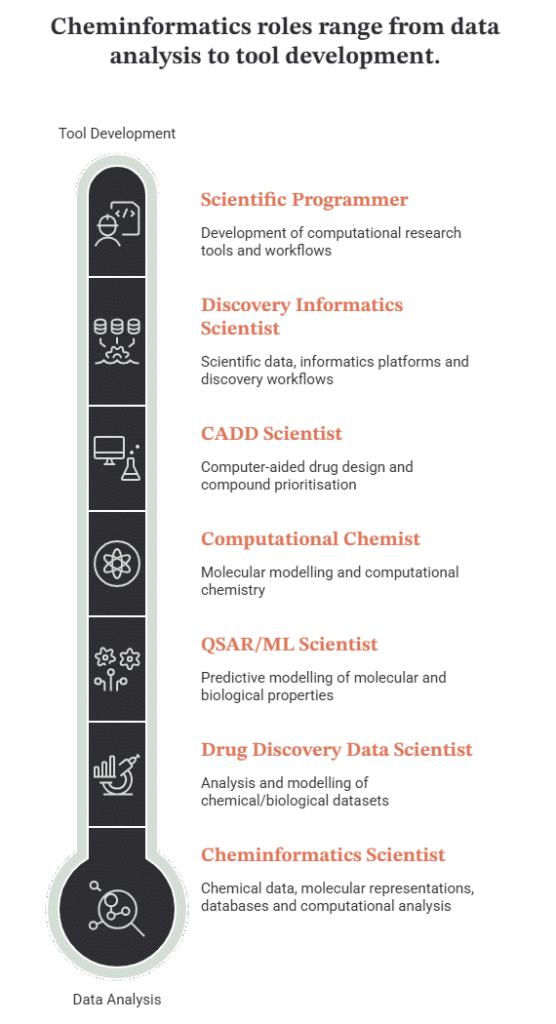
Employers use different job titles depending on the responsibilities, scientific domain, and technical focus of the position. Relevant roles may include:
- Cheminformatics Scientist: Works with chemical data, molecular representations, databases, and computational analysis.
- Discovery Informatics Scientist: Develops and applies informatics workflows to support discovery research.
- Chemical Data Scientist: Cleans, integrates, analyzes, and models chemical and biological datasets.
- QSAR or Molecular Modelling Scientist: Builds and validates predictive models of molecular properties or activity.
- Computational Drug Discovery Scientist: Uses computational methods to prioritize and evaluate compounds for research.
- Scientific Data Curator: Standardizes, annotates, and quality-checks chemical and biological data.
- AI/ML Scientist – Drug Discovery: Applies machine learning to molecular data while working with domain scientists and experimental teams.
Candidates searching for Cheminformatics jobs in India and computational drug-discovery jobs should not rely on a single job title. Employers may advertise relevant opportunities under cheminformatics, discovery informatics, computational chemistry, QSAR, molecular modelling, AI/ML, or scientific data science.
Similarly, chemistry data science jobs may involve cleaning, integrating, analyzing, and modeling chemical or biological datasets even when “chemistry data science” does not appear in the formal job title.
Qualifications vary by employer and position. Some industry roles may accept candidates with a bachelor’s or master’s degree and relevant computational experience. Research scientist, senior scientist, and specialist modelling roles may prefer or require a PhD along with relevant experience.
Applicants should therefore evaluate the complete job description instead of relying only on the title.
Salary for Cheminformatics jobs
When researching cheminformatics salary and Cheminformatics jobs in India, candidates should be cautious about treating any single figure as an industry-wide standard. There is no fixed all-India pay scale for cheminformatics professionals. Job titles overlap, available salary datasets can be limited, and compensation depends on factors such as education, experience, specialization, responsibilities, location, and employer.
The following cheminformatics salary figures should therefore be treated as broad directional estimates rather than guaranteed offers.
| Career Stage | Typical Experience | Broad Indicative Annual Range |
| Fresher or entry-level | 0–2 years | Approximately ₹3–8 lakh |
| Mid-level professional | 3–7 years | Approximately ₹6–20 lakh |
| Senior or principal-level professional | 8+ years | Approximately ₹15–40 lakh or more |
Actual cheminformatics salary can vary according to education, relevant experience, responsibilities, specialization, city, employer, and negotiation.
A candidate with stronger programming, data analysis, cheminformatics, modelling, or domain-specific expertise may qualify for different types of opportunities, but possessing these skills does not guarantee a particular cheminformatics salary.
The cheminformatics salary offered by a pharmaceutical organization may also differ from compensation offered by a CRO, scientific-data company, biotechnology organization, or technology-focused employer.
Some positions may fall above or below the ranges mentioned here. When evaluating Cheminformatics jobs in India, candidates should consider responsibilities, required skills, learning opportunities, career growth, and the advertised cheminformatics salary rather than focusing on the job title alone.
Companies and Organizations Offering Cheminformatics Jobs in India and Related Opportunities
Rather than expecting a fixed list of companies, job seekers looking for Cheminformatics jobs in India should monitor organizations with relevant capabilities or those that periodically advertise work involving computational chemistry, informatics, scientific data, and drug discovery.
These organizations include:
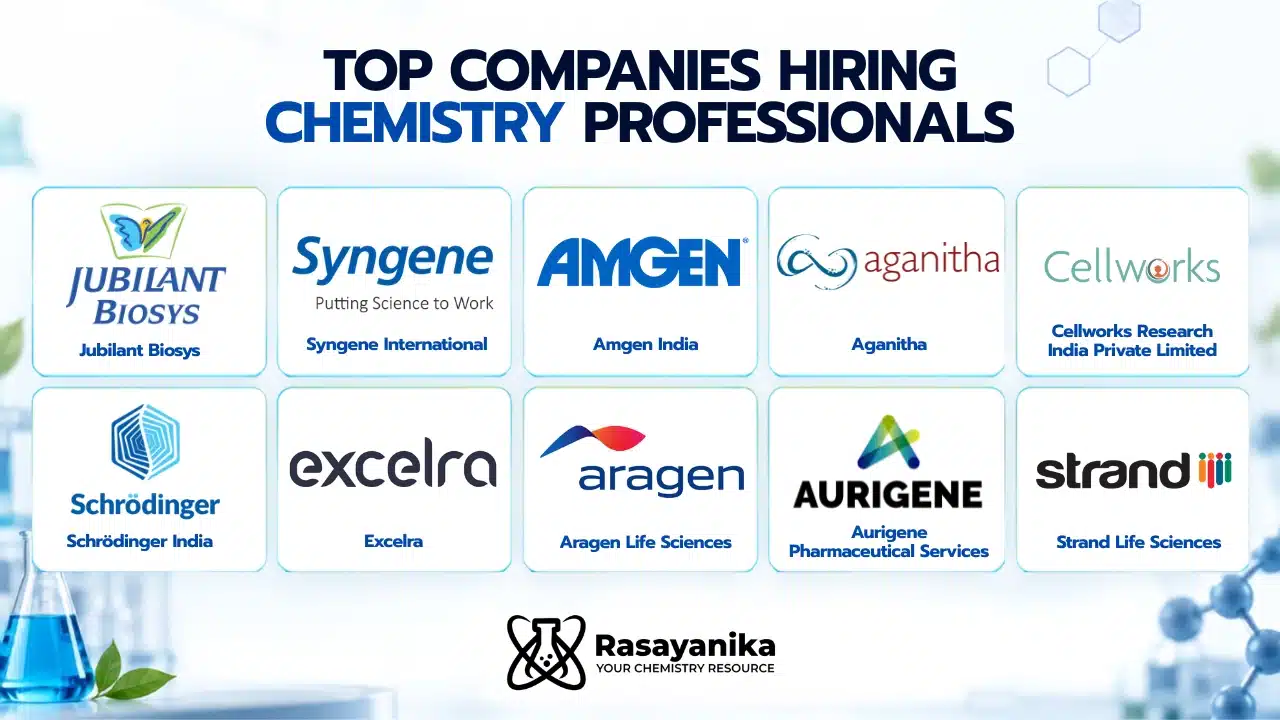
This list highlights organizations with relevant capabilities or that periodically advertise related work. This does not mean that every organization has an active vacancy at the time of reading.
Candidates interested in Cheminformatics jobs in India should verify current vacancies through official company career pages and specialist job portals such as Rasayanika and BioTecNika.
Those searching for computational drug-discovery jobs should also monitor titles such as Discovery Informatics Scientist, Computational Chemist, QSAR Scientist, Molecular Modelling Scientist, Chemical Data Scientist, and Computational Drug Discovery Scientist.
Candidates exploring chemistry data science jobs should additionally watch for positions involving scientific data analysis, chemical data curation, predictive modelling, machine learning, and discovery informatics.
Compensation also differs between organizations, so candidates comparing Cheminformatics jobs in India should evaluate the advertised cheminformatics salary together with the responsibilities, required qualifications, and growth potential.
Career Roadmap for Cheminformatics jobs in India
A chemistry student does not need to become a software engineer before beginning a cheminformatics career. The goal is to build enough computational ability to work reliably with chemical data and solve relevant scientific problems.
Students starting from scratch can first read this cheminformatics career guide for beginners for a broader introduction to the field and its career possibilities, or they can go through the video given below:
A practical roadmap for Cheminformatics jobs in India is
- Strengthen your understanding of chemistry, particularly organic chemistry, medicinal chemistry, and molecular properties.
- Build working proficiency in Python for scientific programming and data analysis.
- Learn molecular representations, including SMILES notation, chemical structures, fingerprints, and molecular descriptors.
- Practice using RDKit, Open Babel, and publicly accessible chemical databases.
- Develop a basic understanding of statistics, data visualization, and machine learning before moving to complex AI methods.
- Study QSAR principles, model evaluation, and validation rather than focusing only on model training.
- Complete two or three relevant projects that demonstrate data cleaning and curation, molecular representation, descriptor calculation, fingerprint-based similarity analysis, or QSAR validation.
- Document the projects clearly through reports, notebooks, or a professional portfolio. Explain the research question, data source, method, validation approach, limitations, and findings.
- Apply for internships and entry-level opportunities involving cheminformatics, computational chemistry, discovery informatics, scientific data analysis, or related work.
Building a portfolio containing chemical-data analysis, molecular descriptors, similarity analysis, or QSAR projects can help candidates demonstrate relevant abilities when applying for Cheminformatics jobs in India and computational drug-discovery jobs.
Likewise, projects demonstrating Python, statistics, data cleaning, visualization, and chemical data handling can strengthen applications for chemistry data science jobs.
Developing stronger and more specialized skills may also influence the types of roles and cheminformatics salary opportunities available to a candidate, although no specific salary level can be guaranteed based on skills alone.
Data quality deserves particular attention. Poorly curated or inconsistent information can produce unreliable computational results. Data cleaning, curation, documentation, and scientific validation are therefore important technical responsibilities, not merely administrative tasks.
Frequently Asked Questions
- Are Cheminformatics jobs in India a good career option?
Cheminformatics can be a promising career for candidates who enjoy both chemistry and computational problem-solving. Opportunities exist across pharmaceutical research, contract research, scientific data services, and technology-enabled drug discovery. However, dedicated vacancies may be fewer than general chemistry or software positions, so candidates pursuing Cheminformatics jobs in India should search using several related job titles.
2. What is the difference between cheminformatics and bioinformatics?
Cheminformatics primarily works with chemical data, molecular structures, compound properties, and reactions. Bioinformatics generally focuses on biological information such as DNA, RNA, protein sequences, and other biological datasets. The two disciplines often work together in research and drug-discovery pipelines.
3. Do I need a PhD to work in cheminformatics?
A PhD is not compulsory for every position. Some roles accept a bachelor’s or master’s degree combined with strong chemistry, programming, and data analysis skills. Specialist research, advanced modelling, senior scientist, and research-lead positions may prefer or require a PhD.
4. Is coding necessary for a cheminformatics job?
Coding is required or strongly preferred in many Cheminformatics jobs in India. Python is particularly useful because tools such as RDKit can be used for molecular-data processing, descriptor calculation, and chemical analysis. The exact programming requirement depends on the responsibilities of the role.
5. Which companies hire for cheminformatics-related roles in India?
Organizations to monitor include Jubilant Biosys, Syngene International, Amgen India, Aganitha, Cellworks Research India Private Limited, Schrödinger India, Excelra, Aragen Life Sciences, Aurigene Pharmaceutical Services, and Strand Life Sciences. Vacancy availability changes frequently, so candidates should verify current openings on official career pages.
6. What can a fresher earn in cheminformatics in India?
An entry-level candidate may encounter offers broadly ranging from approximately ₹3–8 lakh per year. This is only an indicative range and not a guaranteed or standard cheminformatics salary. Actual compensation depends on the candidate’s education, technical skills, project experience, location, employer, and specific responsibilities.
7. What Factors Affect Cheminformatics Salary in India?
A cheminformatics salary can depend on education, relevant work experience, technical expertise, specialization, employer, location, responsibilities, and negotiation. Candidates should therefore avoid treating one online salary figure as representative of every cheminformatics position in India.
8. Are molecular docking and molecular dynamics mandatory skills?
No. They are valuable computational drug-discovery techniques, but they are not essential for every cheminformatics position. They may be particularly relevant to some computational drug-discovery jobs, but candidates should prioritize the skills specifically listed in the job description.
9. Can chemistry graduates apply for chemistry data science jobs?
Yes, depending on the requirements of the individual position. Chemistry graduates who develop relevant skills in Python, statistics, data handling, visualization, chemical databases, and computational analysis may be able to pursue chemistry data science jobs. However, candidates should always check the educational qualifications and technical requirements specified by the employer.
Key Takeaways
Cheminformatics jobs in India reward professionals who combine chemistry knowledge with the ability to organize, analyze, and model molecular data. Programming is valuable, but it must be supported by chemical understanding, reliable data practices, and appropriate scientific validation.
The field includes several career paths, such as cheminformatics science, discovery informatics, chemical data science, QSAR modelling, scientific data curation, and AI-enabled drug discovery. Because employers use different titles, candidates searching for Cheminformatics jobs in India and computational drug-discovery jobs should search broadly and evaluate the responsibilities and required skills of each vacancy.
Similarly, chemistry data science jobs provide another potential pathway for chemistry graduates interested in combining chemical knowledge with programming, data analysis, and computational research.
For graduates interested in Cheminformatics jobs in India, a practical starting point is to build strong chemistry fundamentals, proficiency in Python, and a small portfolio of well-documented chemical-data projects.
Finally, candidates exploring Cheminformatics jobs in India should evaluate cheminformatics salary alongside the nature of the work, responsibilities, learning opportunities, employer, and long-term career growth. The real opportunity in cheminformatics lies in combining chemistry with computational tools to study molecular information, manage complex datasets, and support better scientific research decisions.