


































Chemistry Salary in India: How Much Can BSc, MSc & PhD Chemists Earn in 2026?
Every chemistry student has, at some point, sat through a titration at 11 a.m. and wondered, “Is this actually going to pay off?” It is a very reasonable question for students to ask: “What salary can I expect after studying chemistry?” Chemistry is one of the few degrees that opens opportunities across pharmaceuticals, cosmetics, agrochemicals, food processing, forensic science, energy, advanced materials, and even semiconductors. Yet, few students are clearly told what their BSc, MSc, or PhD in Chemistry may be worth in the job market or what a realistic Chemistry Salary in India looks like at different career stages.
The Quick Picture: Chemistry Salary by Degree
Before the details, here’s the bird’s-eye view. These figures are compiled from the Rasayanika Website Job Posting Survey, Glassdoor India, Payscale, and current industry salary reports and represent typical ranges.
| Qualification | Typical Starting Salary (India) | Indicative Mid-Career Salary Range | Indicative Experienced-Professional Range |
| B.Sc. Chemistry | ₹2 – 3.5 LPA | ₹3.5 – 7 LPA | ₹8 – 10 LPA (role-dependent) |
| M.Sc. Chemistry | ₹3 – 4 LPA | ₹5–8 LPA | ₹15 – 20 LPA (specialized roles) |
| Ph.D. Chemistry | ₹6–8 LPA | ₹10–15 LPA | ₹20 – 35+ LPA (Senior Scientist/Faculty) |
Salary varies significantly by job role, employer, location, specialization, skills, and years of experience.
Professionals working in the fields of pharmaceuticals, petrochemicals, specialty chemicals, materials science, and R&D have the potential to earn more than the ranges outlined previously. In specialized managerial and leadership positions, those in these areas earn substantially more than the ranges presented. Some multinational companies also pay higher amounts, but these figures depend on the employer and position.
BSc Chemistry Salary in India: The Foundation Years
Entry-Level BSc Chemistry salary
The B.Sc. in Chemistry is the first stop in many careers, but it’s also where expectations need to be adjusted most.
- According to the salary references provided above, entry-level private jobs appropriate for B.Sc. Chemistry degree holders may pay in the range of of ₹2–3.5 LPA or roughly ₹16,700-₹29,200 per month gross before deductions. The positions could include laboratory assistant, junior QC analyst, and chemical technician, for example.
- Government-sector BSc Chemistry salary depends on the recruiting organization, post, pay level, allowances, and employment conditions. Eligible positions may offer greater job stability and retirement benefits under the applicable government scheme, but such benefits should not be described as guaranteed for every government appointment.
It is a fact that the upper limit in career scope for a B.Sc. holder does exist, but not in every case.
- For those who have 4-6 years of job experience and have been involved in analytical chemistry, quality control, or the pharmaceutical industry, a BSc Chemistry salary can vary between ₹5–7 LPA, depending on the employer, role, skills, and experience. Those who have acquired specialized analytical skills and work in niche testing areas may earn more than ₹8 LPA.
- There is, however, one disadvantage: the BSc Chemistry salary level in the case of a B.Sc. degree is lower than in the case when a person has advanced degrees.
The practical thing you have to note here is that a B.Sc. is a good starting point for your career. A BSc Chemistry salary can vary depending on the role, industry, skills, and experience. Roles available to BSc Chemistry graduates may include laboratory assistant, junior analytical chemist, QC chemist, production chemist, chemical technician, technical sales executive, and junior testing-laboratory positions. Research scientist roles generally require postgraduate qualifications or substantial relevant experience.
MSc Chemistry Salary in India: Where Pay Starts Growing
It is at this stage that the chemistry salary begins to rise.
- M.Sc. chemistry graduates earn between ₹3 and ₹4 LPA at the start of their careers, but unlike the B.Sc. path, here the rise is much steeper. This starting range provides a useful reference for MSc Chemistry salary expectations.
- Mid-career M.Sc. chemists, especially those already working for 5–10 years in R&D, formulation, or regulatory affairs, earn, on average, between ₹5 and ₹8 LPA.
- While those working in highly sought-after fields like organic synthesis, polymer chemistry, or pharmaceutical formulation can earn even more. These specializations can positively influence the MSc Chemistry salary.
What contributes to the difference for those with an M.Sc. degree is in which areas they have specialization and which sectors they work for. Therefore, an MSc Chemistry salary can differ across career paths.
Let’s understand with a few examples:
- A formulation chemist at a leading pharmaceutical firm,
- an R&D chemist dealing with agrochemicals,
- or a regulatory affairs expert handling drug approvals
These professionals may earn between ₹8 and ₹15 LPA after around ten years in the field, depending on their employer, specialization, responsibilities, and performance. Successful professionals working in managerial or techno-commercial roles may earn more than ₹20 LPA.
Government research roles in organizations such as CSIR laboratories and DRDO follow structured pay scales and may offer greater stability, although private-sector compensation can sometimes grow faster in specialised or managerial positions. Such differences are also reflected in the MSc Chemistry salary across sectors.
PhD Chemistry Salary in India: Higher Research Career Potential
For graduates comparing advanced-degree career paths, an MSc Chemistry salary is also useful as a benchmark.
- A PhD in Chemistry requires the longest period of academic training, and the fellowship received during doctoral research may be lower than the salary available in some full-time industry roles.
- Under the CSIR-UGC NET Junior Research Fellowship, eligible JRFs currently receive ₹37,000 per month for the first two years. Subject to PhD registration, satisfactory research progress, and the required assessment, the fellowship may be upgraded to SRF at ₹42,000 per month for the third and subsequent years. HRA and other benefits depend on the applicable rules and host institution.
- Chemistry is that expensive in terms of opportunity cost. Chemistry salary in India should therefore be evaluated alongside the time required for advanced training and the income a candidate may forgo while completing a doctorate.
However, once the doctorate is done and the graduate becomes a professional scientist or goes into industry or academia, things change drastically. This is where a PhD Chemistry salary can show stronger growth potential.
New Ph.D. chemists entering the industry as research scientists, process chemists, or scientific officers can expect their starting salary to be about ₹6–8 LPA, which is significantly higher than M.Sc. graduates. This is due to the fact that Ph.D. holders have more experience in research and are therefore more valuable to employers.
The growth then continues as follows: A PhD Chemistry salary can increase further with experience and specialization.
- Mid-level PhD professionals working in scientific research, pharmaceuticals, and related industries may earn approximately ₹10–15 LPA, depending on their role, employer, and specialization.
- The senior scientists, principal scientists, and R&D managers at pharmaceutical, specialty chemical, and research entities earn significantly higher, in the range of fifteen lakhs to twenty-five lakhs or more, depending on the experience, skill level, and leadership role they play.
- Faculty compensation at IITs, central universities, and other public institutions follows structured academic pay levels and varies by designation, experience, and applicable allowances.
Based on the highest tier, PhDs looking to set up their own deep-tech or specialty-chemical ventures, or taking a critical position such as CTO at a startup, can earn a lot more, although this financial success comes at a greater degree of risk. Such career outcomes can extend the potential of a PhD Chemistry salary.
What Determines Your Chemistry Career Salary?
In all three fields of study, five factors remain the same for higher-paying occupations:
- Specialization: Expertise in areas such as analytical instrumentation, medicinal and organic synthesis, formulation, process chemistry, polymers, regulatory affairs, and computational chemistry can open access to higher-paying roles than general laboratory positions.
- Industry: Compensation varies considerably across industries. Pharmaceuticals, specialty chemicals, advanced materials, and certain R&D-intensive sectors may offer higher salaries for specialized technical roles.
- Geographic location: Salaries are expected to be higher in Hyderabad, Bangalore, Pune, and Mumbai as opposed to smaller towns. This location difference can influence Chemistry salary in India
- Certifications and tools: The skills included in certifications and tools refer to working knowledge of HPLC, GC, GC–MS, LC–MS, NMR, spectroscopy, development of techniques, validation, GMP/GLP, organic synthesis, process chemistry, and formulation.
- Choice of sector: Government institutions and public-sector organizations generally follow structured pay scales and may offer greater stability and benefits, while private-sector salaries can grow faster in specialized, commercial, or leadership roles.
Popular Chemistry Jobs and Salary Growth Areas in India:
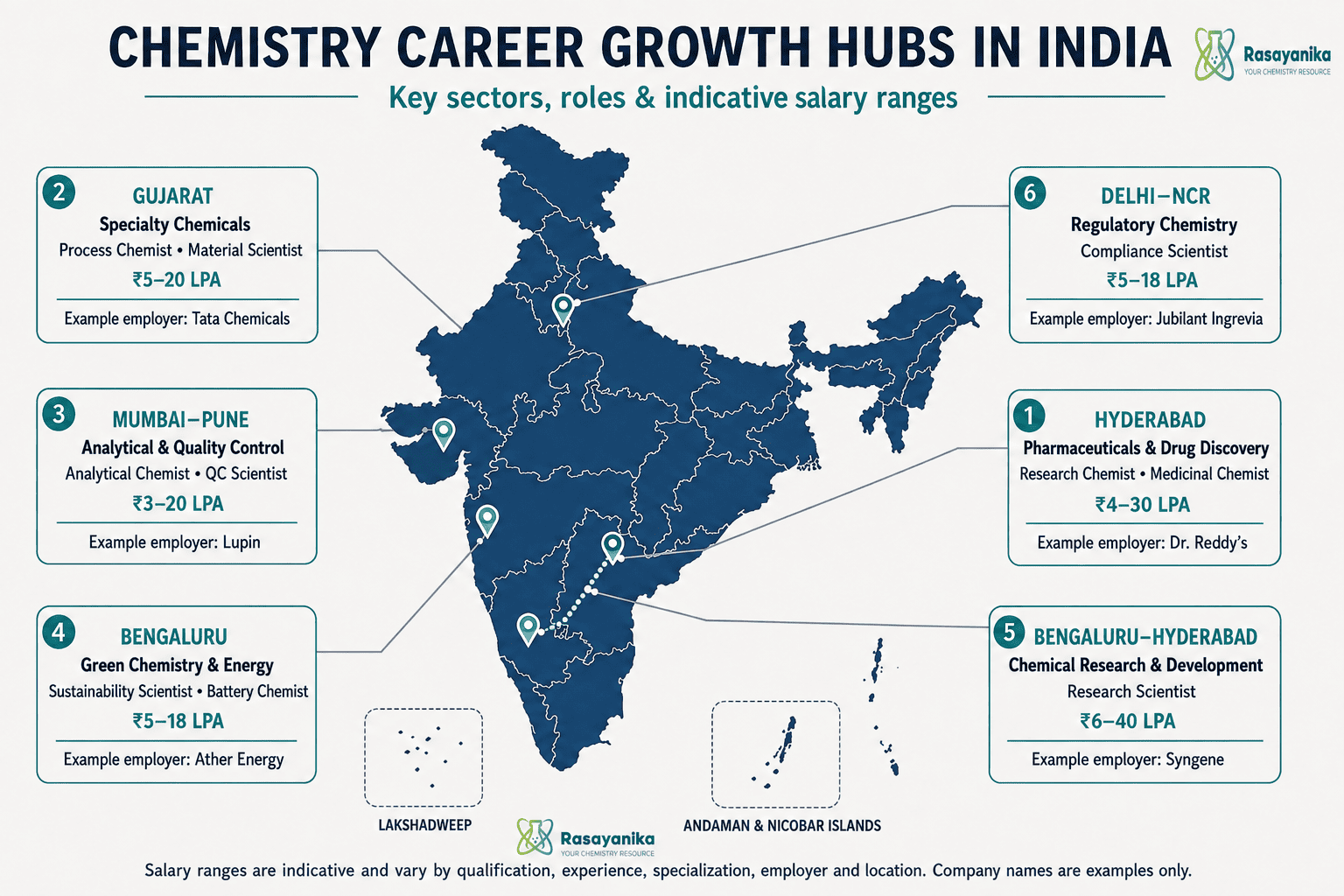
Let’s take a look at how Chemistry salary in India vary across these fields.
| Field of Activity | Employment Opportunities | Salary Levels in India |
| Pharmaceuticals & Drug Discovery | Research Chemist, Medicinal Chemist | Rs. 4-30 Lakhs per annum |
| Analytical & Quality Control | Analytical Chemist, Quality Control Scientist | Rs. 3-20 Lakhs per annum |
| Specialty Chemicals | Process Chemist, Material Scientist | Rs. 5-20 Lakhs per annum |
| Green Chemistry & Energy | Sustainability Scientist, Battery Chemist | Rs. 5-18 Lakhs per annum |
| Chemical Research & Development | Research Scientist | Rs. 6-40 Lakhs per annum |
| Regulatory Chemistry | Compliance Scientist | Rs. 5-18 Lakhs per annum |
Salary ranges are approximate and depend on qualification, experience, location, and specialization. These factors should be considered when comparing Chemistry salary in India.
How to increase your salary:
Are you looking to make more money as a chemist? If so, you should consider implementing the following strategies:
| Career Move | Focus on |
| Master industry skills | HPLC, GC, LCMS, GCMS, NMR spectroscopy, method validation |
| Specialize | R&D, medicinal chemistry, formulation, process chemistry, regulatory affairs |
| Gain experience | Pharma, specialty chemicals, R&D and specialized testing |
| Learn new technologies | Cheminformatics, computational chemistry, data analysis, AI/ML |
| Upgrade education strategically | M.Sc. or Ph.D. for specialized scientist roles |
| Increase your responsibilities | Senior scientist, technical specialist, project manager, other managerial roles |
| Target better job opportunities | Strong employers, specialized jobs, and high-growth industries |
The formula for raised salaries:

Key notes:
The salaries for chemists in India depend on many factors, including educational qualifications, specialization, technical skills, profession, industry, location, and relevant work experiences. These factors all contribute to Chemistry salary in India. A bachelor’s degree in chemistry may help one secure jobs in the laboratory, production, quality control, or commercialization. An advanced degree such as a master’s or a Ph.D. is necessary for some specialized roles in research. Although a degree in chemistry opens many doors for career possibilities, just having an advanced degree does not guarantee a higher salary. This is why the chemistry salary in India should be viewed as a range rather than a fixed figure.
Frequently Asked Questions
- How much does a chemist earn in India?
Chemistry salaries in India vary according to qualification, role, experience, industry, and specialization. BSc Chemistry graduates may start at approximately ₹2–3.5 LPA, MSc Chemistry graduates at ₹3–4 LPA, and fresh PhD holders entering suitable industry roles at around ₹6–8 LPA. Experienced professionals may earn substantially more.
2. Which pays more in India, MSc Chemistry or B.Pharm?
In India, both the MSc Chemistry salary and the B. Pharm salary are broadly similar in range at the entry level. But an MSc in Chemistry helps you get roles focused on chemistry fields such as analytical and process R&D, whereas a B. Pharm offers pharma-focused roles such as pharmacovigilance, formulations, etc. But the key aspects remain the same, as the degree alone doesn’t affect much; it’s the specialization, skills, and experience that play an important role in hiking your salary after an MSc in Chemistry or any degree.
3. Is obtaining a Ph.D. in Chemistry financially beneficial?
A PhD in Chemistry can be financially beneficial for candidates seeking specialized careers in industrial R&D, advanced research, academia, or scientific leadership. However, the return depends on the time invested, research quality, specialization, publication record, technical skills, and eventual career path. Eligible CSIR-UGC NET JRFs currently receive ₹37,000 per month for the first two years. Subject to the applicable conditions and a satisfactory assessment, the fellowship may subsequently be upgraded to an SRF fellowship of ₹42,000 per month.
4. Which area of chemistry earns the most money?
Higher-paying opportunities are often found in medicinal chemistry, process chemistry, advanced analytical sciences, pharmaceutical formulation, specialty chemicals, polymers, battery materials, computational chemistry, and regulatory affairs. Actual compensation depends more on the role, industry, expertise, and experience than on the specialization name alone.