



























Have you completed Class 12 and are looking for the best chemistry courses after 12th? Then this is the article for you. Do you enjoy laboratory experiments, chemistry, medicines, or scientific research? Are you confused about what to choose? You are not alone because choosing the right course can be confusing, especially when options such as BSc Chemistry, Integrated BS-MS, Integrated MSc, and Chemical Engineering lead to different career paths.
Every year, many students complete Class 12 and find themselves in a position where they do not know what to select or what to do next. In this article, we will discuss the best chemistry courses after Class 12. These courses can be suitable if you are deeply interested in chemical sciences.
Chemistry is used in almost every major industry, such as medicines, cosmetics, food products, plastics, paints, clean water, and fuels. Many other products depend on chemistry in one way or another. This is why students choose the best chemistry courses after 12th. They can later find opportunities in research, quality control, manufacturing, environmental testing, materials science, and many other fields.
There is no universally correct course for everyone. Some students enjoy working in a laboratory. Some are more interested in R&D, discovering new things. Others may want to work in factories, manufacturing plants, or large-scale production. Your choice should depend on what interests you. If you are someone who gets excited about research or dreams of discovering something new, then go for: BSc Chemistry, Integrated BS-MS, or Integrated MS can be a good option. If you are interested in machines, manufacturing plants, and large-scale industrial processes, Chemical Engineering may suit you better.
You might be confused right now, but in this article we will discuss the best chemistry courses after 12, their eligibility, specialisations, admission routes, chemistry career options, and salary prospects to help you choose a course that matches your interest and career goals.
Most chemistry programs generally require Class 12 in the science stream with chemistry as a subject. Depending on the course, colleges make different subject combinations, such as:
- Physics, Chemistry, Mathematics (PCM)
- Physics, Chemistry, Biology (PCB)
- Physics, Chemistry, Mathematics, and Biology (PCMB)
Mathematics is normally required for engineering courses, but eligibility requirements and minimum marks vary by institution. Therefore, students should check the latest official prospectus or admission notification before applying. Depending on the university and program structure, undergraduate degrees may follow a 3-year or 4-year format under the current higher education framework.
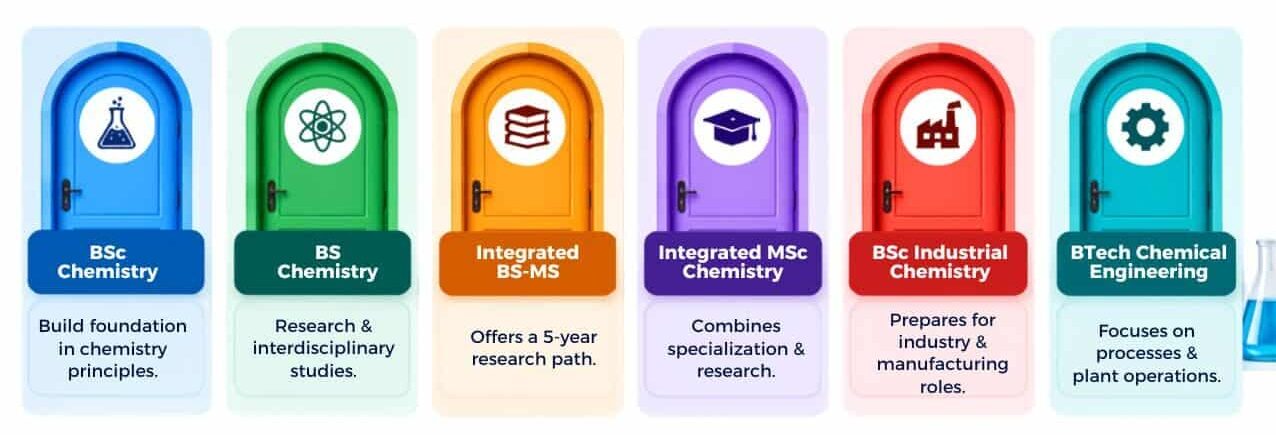
Best chemistry courses after Class 12
Here is a closer look at the options students can consider when choosing the best chemistry courses after 12th:
1.BSc Chemistry
A BSC chemistry course is one of the most common choices for students who want to build a strong foundation in chemistry. Depending on the university and program structure, the degree may follow a 3-year or a 4-year format. Students usually study subjects such as
- Organic Chemistry
- Inorganic Chemistry
- Analytical Chemistry
- Physical Chemistry
- Chemical Thermodynamics
- Spectroscopy
- Electrochemistry
- Chemical Kinetics
- Laboratory Analysis
Some colleges may also offer electives related to food chemistry, polymers, drug design, materials and computer applications. Practical laboratory work is an important part of chemistry education. Depending on the university, students may also get exposure to instrumentation, internships and research projects. Among chemistry courses after 12th, a BSc Chemistry degree is useful for students who may later want to pursue an MSc, enter laboratory-based jobs, work in quality control or move into research.
2 BSc Chemistry
BSc Chemistry is another good option for students with a strong interest in science and research. Some BSc programs may place greater emphasis on research and interdisciplinary study, although the exact curriculum varies between institutions. Students may study chemistry alongside mathematics, physics, computational methods, and other interdisciplinary subjects.
For example, IIT Kanpur offers a BSc program of 4 years in chemistry that includes chemistry courses, laboratory training, electives, and research opportunities. This course can be useful for students interested in scientific research, advanced materials, computational chemistry, or higher studies such as a PhD. Admission is usually done through JEE Advanced, and this pathway can be useful for students interested in scientific research, advanced materials, computational chemistry, or higher studies such as a PhD.
3. Integrated BS-MS program.
This integrated program combines bachelor’s- and master’s-level study into one program that usually lasts for 5 years. In the beginning, students may study different basic sciences such as chemistry, physics, mathematics, and biology. Later, they can move towards a particular subject or major and take advanced courses. Research is an important part of these programs, and students may complete a major research project before graduating.
The Indian Institutes of Science Education and Research (IISERs) are known for research-oriented science education. Their 5-year BSc-MSc programs combine fundamental science, advanced specialisation, and research exposure. The selection process is primarily conducted through the IISER Aptitude Test (IAT), subject to the latest official notification. The integrated BS-MS program can be particularly suitable for students interested in research, higher studies, PhD programs, and scientific careers.
4. Integrated MSc in Chemistry.
An Integrated MSc is another research-oriented option available after Class 12. Institutes such as NISER Bhubaneswar and UM-DAE CEBS Mumbai offer five-year Integrated MSc programmes in basic sciences, including Chemistry. Students first build a broad foundation in science and later move towards specialisation and research. Admission to the five-year Integrated MSc programmes at NISER and UM-DAE CEBS is through the National Entrance Screening Test, or NEST. This path is especially suitable for students who are interested in research, academia or scientific careers.
5. BSc Industrial Chemistry.
Students who are more interested in the industrial use of chemistry can explore industrial chemistry courses. BSc Industrial Chemistry focuses on how chemistry is used in manufacturing and the development of products. Depending on the university, students may study areas such as:
- Industrial chemicals
- Pharmaceuticals
- Cosmetics
- Pesticides
- Industrial catalysts
- Polymers and plastics
- Dyes and pigments
- Fuel chemistry
- Environmental management
- Analytical methods
The course can help students understand how chemical principles are applied to industrial products and processes. Graduates of industrial chemistry courses may explore opportunities in chemical manufacturing, production, quality control, product testing and industrial laboratories. If you are interested in the industrial applications of chemistry, manufacturing or production, BSc Industrial Chemistry may be worth considering.
6.B.Tech Chemical Engineering
Chemical Engineering is a related engineering route, but it is not a chemistry degree. Chemistry primarily focuses on substances, their structures, properties and reactions, while Chemical Engineering focuses on designing, optimising, and operating processes that convert raw materials into useful products at an industrial scale.
- material and energy balances
- fluid mechanics
- heat and mass transfer
- reaction engineering
- process control
- separation processes
- plant design
- safety
Chemical Engineering combines ideas from Chemistry, Physics, Mathematics and Engineering. Graduates can work in industries such as petrochemicals, fertilisers, energy, refineries, pharmaceuticals and manufacturing.
Popular chemistry specialisations
After comparing chemistry courses after 12th, choosing the correct degree is only the first step. As you continue studying chemistry, you may develop an interest in a particular specialisation. Here are the common ones:
- Analytical Chemistry: This is the study of identifying and measuring substances using analytical instruments such as HPLC, GC, spectroscopy, and titration.
- Organic Chemistry: This is the study of carbon compounds, reaction mechanisms, and synthesis. This is mostly useful in the pharmaceutical, agrochemical, and polymer industry.
- Inorganic Chemistry: This is the study of metals, minerals, coordination compounds, catalysts, and organometallic compounds. Basically, it involves the composition of matter.
- Physical Chemistry: This is the study of thermodynamics, kinetics, quantum chemistry, and electrochemistry.
- Industrial Chemistry: This involves manufacturing processes, catalysts, fuels, polymers, and product testing. This focuses on the applications of the fundamentals of the theory.
- Pharmaceutical Chemistry: This involves the study of drug molecule synthesis, analysis, and medicinal compounds and is one of the essential parts of drug discovery.
- Environmental Chemistry: This is the study of pollution, monitoring, water testing, waste treatment, and sustainable processes.
- Materials and Polymer Chemistry: It involves the study of materials such as plastic coatings, ceramics, composites, nanomaterials, and energy materials, etc.
- Computational Chemistry: It involves the combination of chemistry with computer-based methods such as modelling, programming, and data analysis applied to molecules and materials.
The American Chemical Society similarly lists multiple chemistry fields, including analytical, organic, inorganic, physical, environmental, medicinal, forensics, and materials chemistry. These fields broadly align with specialisations and electives offered by many Indian universities.
Admission Routes
For chemistry courses after 12th, admission may depend on the institution and programme and may be based on:
- Class 12 marks
- CUET-UG for participating universities
- University-level entrance examinations
- IAT for IISER programmes
- NEST for NISER Bhubaneswar and UM-DAE CEBS Mumbai
- JEE Advanced for IIT undergraduate BS programmes such as IIT Kanpur’s BS Chemistry
- JEE Main, JEE Advanced or state-level engineering entrance examinations for BTech programmes, depending on the institution
Students should check the latest official admission notification before applying, as eligibility requirements and admission routes may change.
Chemistry career options
You must be wondering “Which course should I pick?” The career opportunities available after a chemistry degree depend on your qualification, specialisation, practical skills and experience. Some entry-level chemistry-related roles include:
- Junior Chemist
- QC chemist
- QA chemist
- production chemist
- laboratory analyst
- RD assistant
- chemical testing executive
- environmental laboratory analyst
- documentation executive
- scientific content writer, etc.
Chemistry professionals have a wide range of chemistry career options, such as pharmaceuticals, chemicals, food testing, cosmetics, and agrochemicals, paints, polymers, environmental laboratories, universities, and government research institutions. Which is why chemistry rarely feels like a narrow subject once you are actually working in it.
However, not every chemistry degree directly qualifies a candidate for every role. Some laboratory and QC roles may accept BSc graduates, while research, specialist analytical and advanced R&D roles may prefer an MSc, professional training or relevant experience.
What are the important skills for successful chemistry careers?
The skills required in chemistry vary depending on the career path you choose. Some useful foundational skills include:
- Laboratory safety
- Solution preparation and standardisation
- Wet chemistry techniques
- Instrument handling
- Basic spectroscopic techniques
- Data interpretation
- Scientific documentation
- GMP, GLP and laboratory-documentation practices, depending on the industry
- Communication and teamwork
- Problem-solving
Analytical techniques such as HPLC and GC are particularly relevant to analytical, pharmaceutical and QC roles. Microscopy may be useful in specific areas such as materials science and research, while programming and data-analysis skills can be valuable for computational chemistry. Internships and hands-on laboratory training can help students understand how these skills are applied in laboratory and industrial settings.
Approximate salary range in India:
Salaries in chemistry-related careers vary depending on the specific job role, qualification, experience, location, industry and practical skills. Therefore, salary figures should be treated as indicative rather than guaranteed. Entry-level roles such as QC Chemist, Production Chemist, Laboratory Analyst and Research Chemist may have different salary ranges. Candidates with higher qualifications and relevant practical experience may have access to more specialised opportunities. Skills in areas such as analytical instrumentation, GMP, GLP, regulatory documentation and computational chemistry may also be valuable for specific roles as candidates gain experience.
Conclusion
There is genuinely no universal course that suits every student. A BSc Chemistry course provides a broad foundation; BS Chemistry and Integrated BS-MS programmes are especially suitable for research-oriented learners; industrial chemistry courses focus more directly on industrial applications; and Chemical Engineering is appropriate for students interested in large-scale processes and plant operations.
Before choosing a college, compare the syllabus, laboratory facilities, internship opportunities, recognition of the institution and placement record. More importantly, do not choose a course only because someone tells you that it has “scope.” Think about the kind of work you actually enjoy. The best chemistry courses after 12th are those that match your interests, strengths and long-term career plans. A good degree, practical laboratory experience and industry-relevant skills can together help you build a strong career in chemistry.